Articles
Spring Clean Your Therapy Practice
Spring is the perfect time to make small changes that support sustainability. This guide takes a provider-centered approach, without overhauls or pressure to do everything all at once.


The fresh-start energy of spring can motivate you to declutter, reorganize, and upgrade the most neglected parts of your home, and the results can be liberating. When you clear the kitchen counter or sort through drawers and closets, you're not only making space, you're reducing the number of unresolved decisions your brain is quietly tracking, freeing up mental bandwidth.
Similar (or dare we say bigger?) rewards await when it comes to tidying up your private practice. Doing things like updating policies, reviewing key financials, or finally setting that response-time boundary can lead to decreased cognitive noise and more capacity for what matters most (Nguyen & Tran, 2025).
The goal of this article is to help you focus on a few key areas of your practice where a little spring cleaning can make a noticeable difference in your day-to-day.
Update policies to protect your boundaries
Blurred professional boundaries are often a direct contributor to burnout; clinicians describe being pushed beyond the traditional limits of the therapeutic relationship as a primary source of fatigue and discomfort, with boundary clarification emerging as a key recovery strategy (Vivolo et al., 2024).
If you really think about it, paperwork is your first boundary-setting opportunity with clients. From your intake forms, to cancellation policies, and other information found in your informed consent, these are clinical boundaries made visible.
Spring is a perfect time to re-read your own policies as if you were a new client. Here are just a few things worth considering, especially if you haven’t updated your paperwork in a while.
Consider refreshing these policies first:
- Late-cancellation policy
- Does it protect against lost income due to last-minute cancellations?
- Do you share this policy with clients during intake?
- Is the policy written clearly and concisely?
- Have you been enforcing this policy? If not, what might empower you to do so?
- After-hours contact policy
- Does your policy clearly indicate when you’re available to clients?
- Does it clarify whether you can be reached by email, phone, or text?
- Does it provide 24-hour crisis resources?
- Have you been enforcing this policy? If not, what might empower you to do so?
- Consent forms
- Do they describe your theoretical orientation in clear, simple terms?
- Do they include possible reasons for clinician-initiated termination?
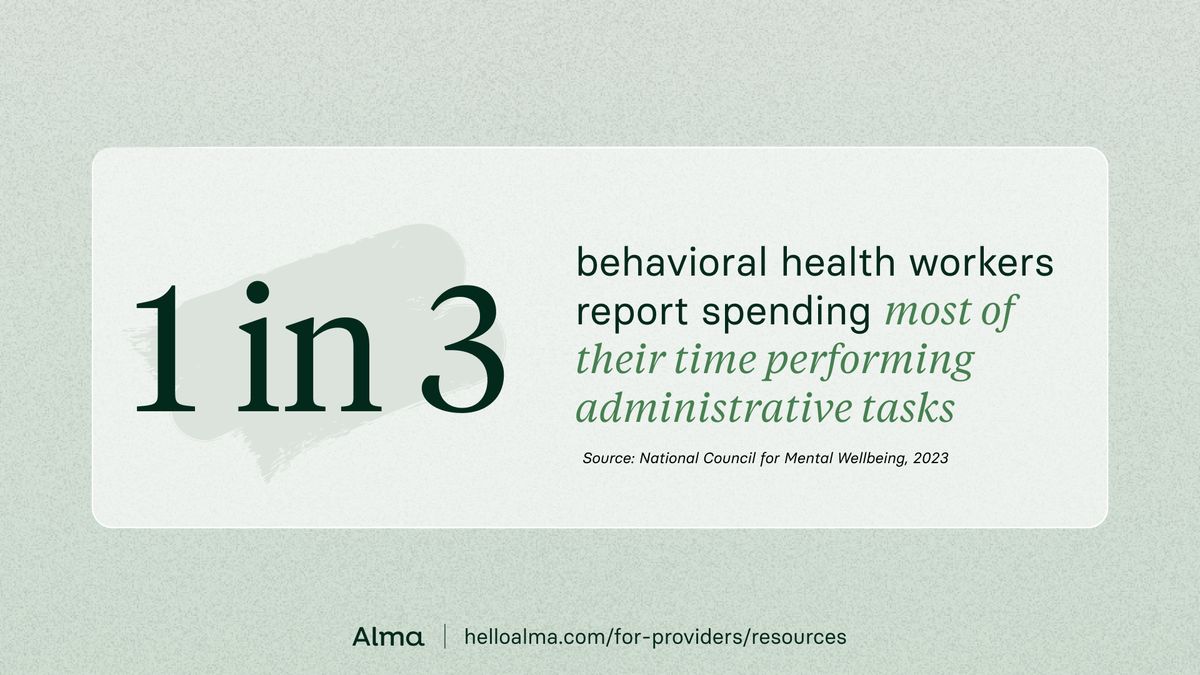
Adjust fees based on your current finances
According to the research, only 33% of clinicians raised their fees in 2024 (Bryan-Podvin, 2024). This very likely means that the majority are effectively earning less per hour than they were the year before. If you are working more than 40 hours a week to make a livable salary, you are overextending—and financial depletion is part of burnout.
While there are things out of your control, like insurance reimbursement rates, you can ensure you are not short-changing yourself by addressing these few areas:
Self-pay rate
You spent years in graduate training learning to do one of the hardest jobs in healthcare, and you're likely charging less per hour than your accountant.
The average cost of therapy without insurance is typically $100 to $250 per session, with self-pay fees set by providers based on training, experience, and practice expenses (Collins, 2025). Your fee is a clinical boundary, too, and it may be overdue for the same attention you give everything else in your practice.
Sliding fee scale
We know access to care is a barrier. A 2024 cross-sectional analysis of more than 175,000 private practice psychotherapy providers found that cost and insurance coverage remain significant barriers to mental health care (Zhu et al., 2024). Providing affordable sessions is part of ethical care.
Of course, affordable for one client means something different for another. Check whether your sliding scale slots are intentional or just accumulated over time.
Cancellation fees
Clinicians can struggle with following through on already existing policies like charging the cancellation fee. Both Marschall (2024) and Griswold (2025) shared that clinicians waive no-show and late cancellation fees more often than they enforce them, even to their own detriment, and even if they have a clearly written cancellation policy.
We strongly feel for our clients and we know their circumstances which can make it difficult to send “that” invoice. Can you adopt a one time courtesy policy for the last minute cancellation or no show? Then readjust your cancellation fee to a reasonable amount that you can comfortably apply for all future cancellations? While there is no standard rate across the country, if you think of your time as valuable and create a rate based on that your clients will respect it.
Keep in mind that a fee that supports you allows you to be fully present and resourced for your clients (Bryan-Podvin, 2024).
Take a fresh look at your caseload
Therapy isn’t meant to be forever. It might be time to take a good look at your caseload and evaluate what both you and your clients need. Therapists report the highest mental fatigue and loss of motivation and interest of any healthcare specialty (Tebra, 2025). And, caseload composition directly affects burnout.
Maintaining clear boundaries is an important protective factor against burnout. More specifically, research highlights that boundaries around role limits, levels of responsibility, and caseload size can meaningfully reduce emotional exhaustion (Duncan & Pond, 2024).
Questions to ask yourself:
Are you holding cases that have exceeded your clinical scope?
Follow-up: Are there clients who have plateaued and could use the skills for someone more specifically trained in their area of need?
Are there clients in a maintenance pattern where referral or step-down care might actually serve them better?
Follow-up: Is independence and self-sufficiency a part of the client’s treatment plan?
Are your pro bono or reduced-fee slots still aligned with your current capacity and values?
Follow-up: Are you saying yes to more out of guilt or is it based on value alignment?
Could extra services serve you better?
In addition to your clients, it’s important to reevaluate your other clinical commitments.
Supervision groups, consulting roles, and committee work: Assess whether these activities still align with your values and are rewarding in a meaningful way. Are you being compensated for your efforts? Are they leading to increased referrals, or recognition through conference presentations or publications?
Pro bono supervision: While this is one way clinicians can align with ethical expectations, it is easy to overextend yourself. If you’re spread thin, most licensing boards allow triadic supervision (two supervisees during the hour) which would save time but still meet the needs of interns/associate licensed clinicians.
Reinvest in your wellness
Now it’s time to think about your own wellbeing; because burnout doesn't just affect you, it affects your clients. Researchers have found that clinically meaningful improvement occurred less in clients under the care of burned-out clinicians compared to those without burnout (Sayer et al., 2024). Burnout impairs attention, memory, and executive function, leading clinicians to narrow their focus to only the most pressing demands (AHRQ, 2023). A depleted clinician is less effective.
The University of New Hampshire has expanded our definition of wellness to 8 domains. Let’s use this to provide clear, realistic strategies to spring clean your clinical practice today.
Emotional Wellness
Consider auditing whether your cancellation policy reflects what you actually enforce. If not, start enforcing it to reduce the low-grade resentment and moral dissonance that quietly erodes emotional stability over time.
Environmental Wellness
Consider scheduling your monthly strategic thinking session outside your office; a coffee shop, a walk, a hotel lobby, directly shifts your cognitive and emotional state by removing the visual cues that keep your brain locked in "work mode."
Financial Wellness
Consider reviewing your self-pay fee annually and treating it like the professional rate it is, not the number you picked nervously when you first opened your practice.
Intellectual Wellness
Consider redesigning your session note templates to reflect how you actually think and practice today, not the format you inherited from a supervisor ten years ago. This is a small act of clinical self-respect and professional growth.
Occupational Wellness
Consider batching administrative tasks into dedicated time blocks creates a cleaner boundary between clinical work and business work which is fundamentally what makes private practice feel sustainable rather than chaotic.
Physical Wellness
Consider building genuine 10-15 minute restorative breaks between sessions (not scroll time or email) protects the nervous system from cumulative compassion fatigue across a full clinical day.
Social wellness
Consider building peer consultation into your regular schedule ensures you're not making hard clinical decisions in isolation and that someone who understands your work actually knows how you're doing.
Spiritual Wellness
Consider the monthly reflection hour, the one where you ask Is this still the practice I want? is essentially a values clarification exercise. It reconnects daily decisions to the reason you entered this field in the first place.
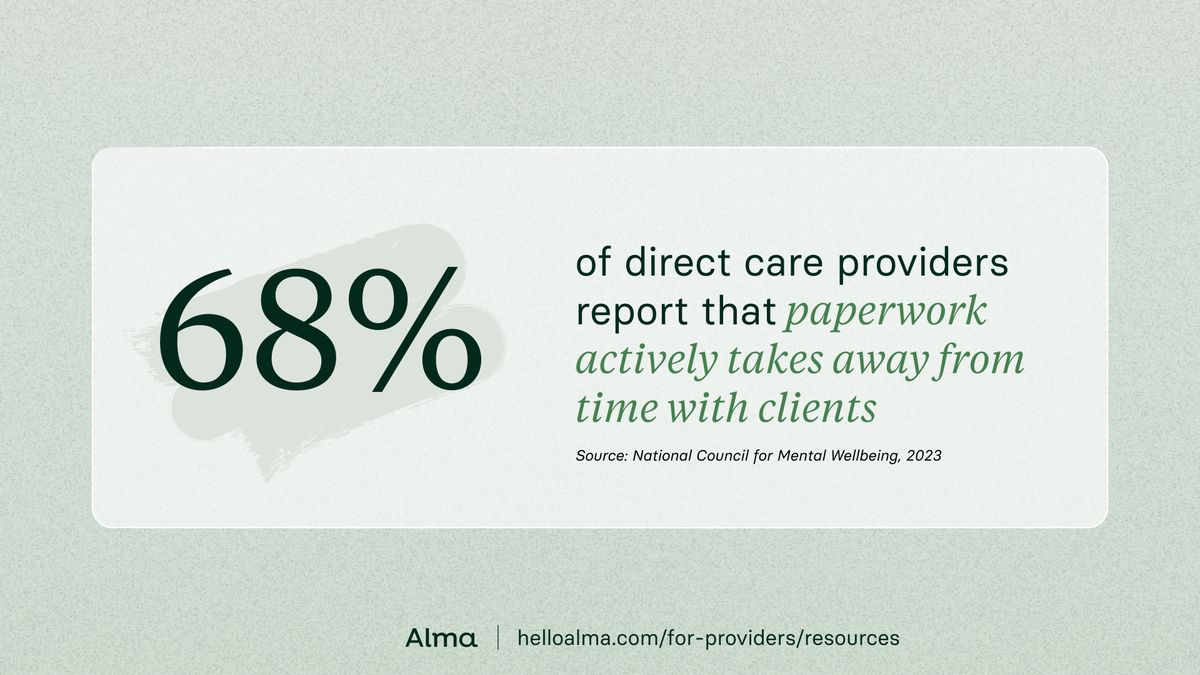
Simplify admin work with an all-in-one platform
If you’re using several different tools to manage your client scheduling, handle billing and insurance paperwork, access continuing education, connect with peers, and take compliant session notes, you’re spending hours every month jumping from one website to the next.
Switching to an all-in-one platform like Alma can help you spend significantly less time on administrative tasks and free up the mental energy it takes to “code-switch” several times a day.
Start spring cleaning your practice Today
The American Psychological Association's 2024 Practitioner Pulse Survey found that roughly one in three therapists reported feeling burned out and that number climbs to one in two among early-career clinicians (those within their first ten years of practice; APA, 2024).
Clearing clutter in your daily clinical practice can help you prevent burnout. Try to think of it as an essential function to your wellness which will directly impact the wellbeing of your clients. Small intentional efforts build a fresher, healthier practice that holds you up instead of wearing you down.
References
Agency for Healthcare Research and Quality. (2023). Burnout among health professionals and its effect on patient safety. Patient Safety Network.
American Psychological Association. (2024). 2024 practitioner pulse survey. https://www.apa.org/pubs/reports/practitioner/2024
Bryan-Podvin, L. (2024, March 10). How to set your fees in private practice (plus 3 mistakes to avoid). Heard.
Collins, D. (2025, December 27). Average cost of psychotherapy: Session fees and what affects price. MyPsychotherapy
Duncan, S., & Pond, R. (2024). Effective burnout prevention strategies for counsellors and other therapists: A systematic review and meta-synthesis of qualitative studies. Counselling Psychology Quarterly, 37(4), 526–555. https://doi.org/10.1080/09515070.2024.2394767
Griswold, B. (2025, February 27). Missed sessions: The cost of being too nice. Navigating the Insurance Maze.
Jones-Ford, S. (n.d.). Love your workflow: A productivity guide for therapists. Alma.
Marschall, A. (2024, January 25). Let's talk about cancellation fees. Resiliency Mental Health. https://resiliencymentalhealth.com/2024/01/25/lets-talk-about-cancellation-fees/
National Council for Mental Wellbeing. (2023). Help wanted: The behavioral health workforce shortage. The Harris Poll.
Nguyen, M. T., & Tran, N. U. M. (2025). The impact of workplace environment on concentration and cognitive performance: A cognitive psychology perspective. GPH-International Journal of Social Science and Humanities Research, 8(8), 72–86. https://doi.org/10.5281/zenodo.17213559
Sayer, N. A., Spoont, M., Ackermans, L., Murdoch, M., Orazem, R. J., Rosen, C., & Kehle-Forbes, S. (2024). Clinician burnout and effectiveness of guideline-recommended psychotherapies. JAMA Network Open, 7(4). https://doi.org/10.1001/jamanetworkopen.2024.6512
Tebra. (2025). Physician burnout by specialty 2025: Navigating stress in the healthcare industry. https://www.tebra.com/theintake/staffing-solutions/independent-practices/physician-burnout-by-specialty
Vivolo, M., Riccardi, I., & Sperandeo, R. (2024). Burnout and coping strategies in integrative psychotherapists: Findings from qualitative interviews. International Journal of Environmental Research and Public Health. https://pmc.ncbi.nlm.nih.gov/articles/PMC11431683/
Zhu, J. M., Huntington, A., Watson, K., Deshmukh, A., Wolk, C., & McConnell, K. J. (2024). Insurance acceptance and cash pay rates for psychotherapy in the US. Health Affairs Scholar, 2(9). https://doi.org/10.1093/haschl/qxae110


Written by
Drs. Jill Krahwinkel-Bower and Jamie Bower





Learn More
Build a thriving private practice with Alma
We believe that when clinicians have the support they need, mental health care gets better for everyone.