Articles
A 3-Tiered Wellness Action Plan for Therapists
Caring for yourself as a clinician is never easy. These realistic, time-based goals will get you started — and four printable worksheets will help you follow-through.

As a therapist, you likely spend a significant portion of every day helping others explore their pain, process their trauma, and build lives worth living. And somewhere between session four and session seven, you realize you haven’t even paused to take a sip of water.
Of course, this isn’t just a matter of “self-care.” Your wellness is a clinical and ethical issue, in addition to a personal one. Each of the mental health field’s respective codes of ethics (ACA, APA, CSWA) require monitoring one’s own effectiveness and taking appropriate steps to address impairment.
As much as you might know and understand this, it can be extremely hard to act on. Research shows that around half of clinicians experience moderate rates of compassion fatigue and up to 60% experience burnout (Bentley, 2022).
Another hard truth: Compassion fatigue and burnout can have serious consequences, including reduced attunement to client needs (inadvertently risking harm), boundary and ethical violations, negative client outcomes, and premature exit from the profession.
Fortunately, research demonstrates that resilience has a strong negative relationship with burnout, meaning that if you actively build resilience, you can experience significantly less burnout over time.
Wellness is a protective, transformative practice that enhances your clinical effectiveness and sustains your career. In this guide, we explore the many aspects of wellness, and provide you with a diverse action plan that includes three tiers of wellness-building strategies.
Wellness is truly multidimensional
The Substance Abuse and Mental Health Services Administration (SAMHSA) adopted a groundbreaking framework for understanding wellness that identifies eight interconnected dimensions (see list at right). Each dimension is essential to a complete, flourishing life (SAMHSA, 2016; Swarbrick, 2023). When one dimension suffers, others tend to follow.
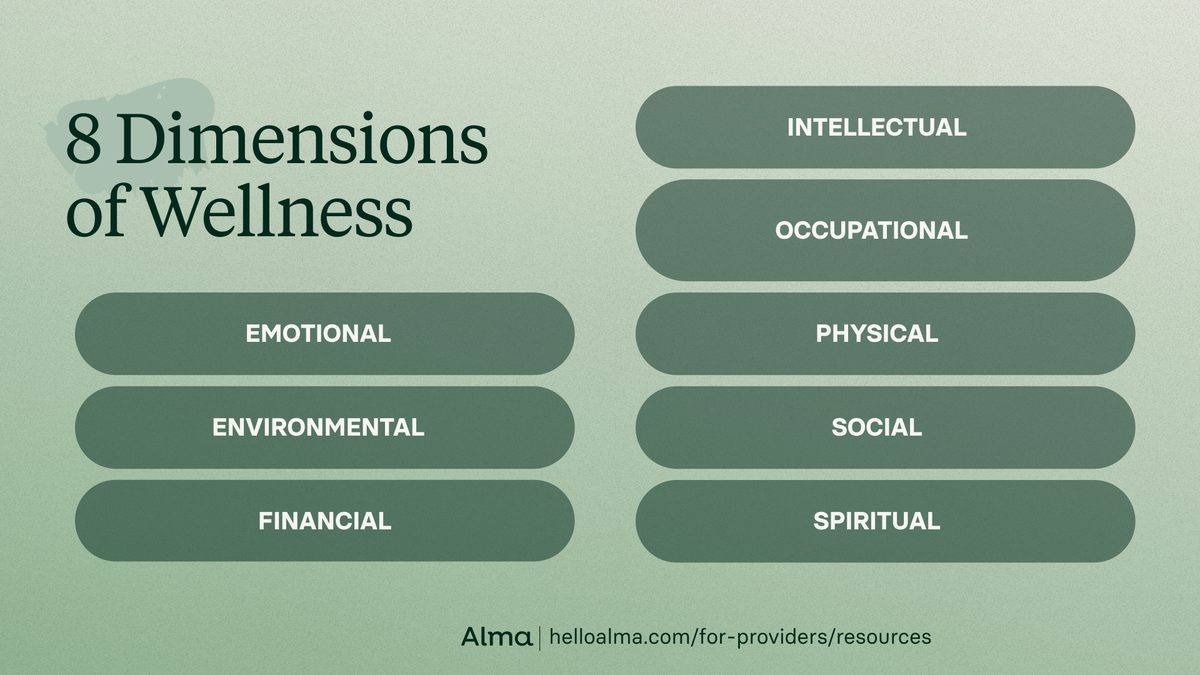
EMOTIONAL: Your ability to navigate your own internal world, regulate affect, and maintain healthy relationships.
ENVIRONMENTAL: The physical and psychological safety of your surroundings.
FINANCIAL: Satisfaction with your current and future financial situation.
INTELLECTUAL: Engaging your curiosity, creativity, and desire to grow.4.
OCCUPATIONAL: Finding meaning, satisfaction, and balance in your work.
PHYSICAL: Attending to sleep, movement, and nutrition.
SOCIAL: Developing a sense of connection, belonging, and a well-developed support system.
SPIRITUAL: Recognizing and expanding your sense of purpose and meaning in life.
Choose strategies for quick relief as well as lasting change
Often, the thought of taking care of yourself can feel overwhelming. With so little time and energy to do all the things you have to do, it can feel like just another burden.
The following three-tier action plan was created with this reality in mind.
From intentional pauses, to balancing habits, to major shifts, you can choose the options that feel accessible and rewarding to you.
Tier One: In the next fifteen minutes
These are small, accessible, evidence-informed actions you can take immediately, between sessions, during a lunch break, or right after reading this sentence. Each one addresses at least one of the eight wellness dimensions. Consider picking one or more to do on a regular basis.

1. Drink a full glass of water and eat something nutritious. (Physical)
If you haven’t done this yet today, it’s a good place to start.
Why it works: Basic physical care is the foundation on which every other wellness strategy rests.
2. Do a body scan. (Emotional, Physical)
Sit comfortably, close your eyes, and slowly scan your attention from the top of your head to the soles of your feet. Notice where you are holding tension… your jaw, your shoulders, your chest. Name it. Breathe into it.
Why it works: Mindfulness interventions, even brief practices, yield significant benefits including stress reduction, increased empathy and compassion, and enhanced self-efficacy among clinicians.
3. Write three sentences in a journal. (Emotional, Intellectual)
Three sentences. One about what you are feeling right now, one about what you are grateful for today, and one about what you need.
Why it works: Reflective journaling is one of the most consistently recommended self-care strategies in the counseling literature, and it costs nothing but a few minutes.
4. Step outside for 10 minutes. (Physical, Environmental, Spiritual)
Not to check your phone, not to make a call, just to be outside.
Why it works: Nature exposure, even brief, reduces cortisol, lowers heart rate, and creates a sensory reset that office environments simply cannot replicate.
5. Send one brief message to someone who supports you. (Social)
A text to a friend, a colleague you trust, a mentor. Two sentences. “Hey, rough day. Thinking of you.”
Why it works: Peer support has been shown to improve growth and wellness, as well as support self-awareness among clinicians.
6. Name your current emotional state, out loud or in writing. (Emotional)
Say it or write it: “I am frustrated. I am exhausted. I am actually doing okay.”
Why it works: Self-awareness (including mindful attention to thoughts, feelings, and behaviors in the self) is as core to wellness as it is the work you do.
7. Take three slow, deliberate breaths before your next session. (Emotional, Physical)
Why it works: Diaphragmatic breathing activates the parasympathetic nervous system, reduces physiological stress responses, and helps you arrive fully present.
Tier Two: In the next month
Monthly-level change is where wellness practices start to become habits. These strategies require some intentionality and a bit more time investment, but are still accessible without major life overhaul. If you feel able, choose one or more to start this month.

1. Establish a brief daily mindfulness practice. (Emotional, Physical, Spiritual)
Start small, five to ten minutes per day. There are several apps that offer free or low-cost guided meditations.
Why it works: A month of consistent daily practice, even brief, begins to produce measurable neurological and emotional change (including reduction in perceived stress and reduction in burnout symptoms; Su & Luo, 2024).
2. Complete a formal self-care assessment. (All Eight Dimensions)
Use a structured tool like the Professional Quality of Life Scale (ProQOL) which is freely available and specifically normed for helping professionals. It measures compassion satisfaction, burnout, and secondary traumatic stress.
Why it works: Accurate assessments help you track improvement over time.
3. Establish one physical wellness routine. (Physical)
A twenty-minute walk three times a week; a nutritious mid-morning snack; a yoga class; a regular bedtime; getting up to stretch once an hour. Pick the area of physical wellness most neglected right now (sleep, movement, or nutrition) and make one specific, adjustable change.
Why it works: Physical wellness is the foundation of all other types of wellness — tending to it first is key to feeling your best and doing your best work.
4. Create and enforce one professional boundary. (Occupational, Emotional)
Choose the boundary that would create the most immediate relief, for example avoid checking work email after 5:00 PM, scheduling a five-minute reset between sessions, or saying no to one additional task in an area of your work where you have been over-functioning.
Why it works: Professional Clinicians who maintain healthy boundaries and engage in regular wellness practices are more effective clinically.
5. Begin or reinstate a peer consultation relationship. (Social, Occupational, Intellectual)
Reach out to a colleague or small group for regular, informal peer consultation. Once a week, or even twice a month, is enough to meaningfully reduce professional isolation. This is especially important for clinicians in private practice; isolation accelerates burnout faster than almost any other variable.
Why it works: Clinicians with a supportive environment are more satisfied with their employment; and peer support significantly improves growth, wellness, and self-awareness.
6. Conduct a financial wellness check-in. (Financial)
Even one conversation with a financial advisor, or one hour reviewing your budget, is a meaningful step in improving financial wellness.
Why it works: This dimension is frequently neglected in clinician wellness conversations, but financial stress is a consistent driver of burnout.
7. Explore or deepen a spiritual practice. (Spiritual)
This means exploring whatever connects you to meaning, purpose, and something larger than your caseload. So prayer, meditation, time in nature, creative expression, and community can all qualify.
Why it works: Clinicians who maintain a clear sense of purpose are more resilient under pressure and experience higher rates of compassion satisfaction (Stamm, 2009).
Tier Three: In the next three months
This tier is about creating sustainable, systemic change. These are the strategies that, when implemented over 90 days, can fundamentally shift the trajectory of your career and your well-being. They require more time, more intention, and in some cases more courage.

1. Begin or return to personal therapy. (Emotional, Intellectual, Spiritual)
Clinician educators consistently recommend personal therapy as a self-growth experience that increases self-awareness in preparation for and continuation of professional practice, yet after training it becomes less clear how, if at all, practicing clinicians access therapy for their own development.
Why it works: Personal therapy can reduce secondary traumatic stress and enhance the empathic attunement you bring to your clients.
2. Pursue or reinstate clinical supervision. (Occupational, Emotional, Intellectual)
Over three months, commit to a regular supervision relationship. This is especially important for those in private practice, who often carry their clinical material entirely alone.
Why it works: The lack of ongoing clinical supervision is a significant source of burnout for many clinicians — and supervision in almost any organizational setting is a strong strategy for alleviating and preventing burnout symptoms.
3. Complete a formal wellness inventory and build a written wellness plan. (All Eight Dimensions)
Use SAMHSA's Eight Dimensions of Wellness as a framework (Swarbrick, 2023). Rate yourself honestly in each area. Identify one goal per dimension. Write it down.
Why it works: Research consistently shows that written goals are significantly more likely to be achieved than unwritten ones. Revisit this plan at the 30-day and 90-day mark.
4. Engage in a structured mindfulness-based program or CE course that incorporates wellness. (Emotional, Physical, Spiritual, Intellectual)
For example, consider joining an online MBSR, MBCT, ACT program. Or deliberately seek out training in areas that replenish your clinical identity, expand your toolbox, or directly enhance the quality of your work while simultaneously building your own protective factors against burnout.
Why it works: Participating in one of these programs or courses will enhance competency in wellness, self-care, and self-awareness.
5. Evaluate and restructure your professional environment. (Environmental, Occupational, Financial)
Look honestly at your workspace, your caseload structure, and your organizational context. Over three months, identify one meaningful structural change (a reduction in caseload, a redesigned workspace, or a renegotiated role expectation) and pursue it.
Why it works: High client demand, administrative burden, and compassion fatigue are three of most cited contributors to burnout among mental health practitioners.
6. Build or formalize your social wellness network. (Social)
This might mean joining a professional organization, attending a conference, establishing a peer consultation group, or deepening existing collegial relationships.
Why it works: Peer support and connected professional relationships have the power to reduce the likelihood of compassion fatigue. Think of connection as a clinical intervention for yourself.
7. Develop a professional identity and values statement. (Occupational, Spiritual, Intellectual)
Take time over three months to articulate, in writing, why you do this work, what your core professional values are, and what kind of clinician you want to be ten years from now.
Why it works: Clinicians who maintain clarity about their professional identity report higher job satisfaction and are better protected against occupational burnout.
Make wellness a practice
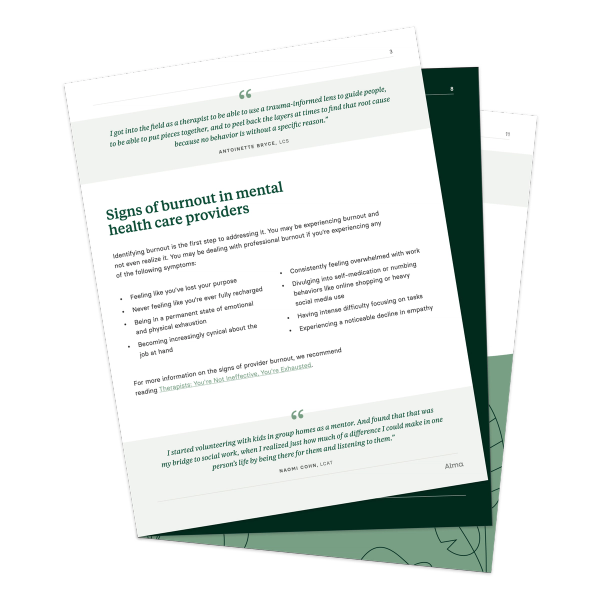
Structure and accountability are always helpful in supporting change. Download a PDF of this resource that includes four free worksheets to help you decide which steps you’ll take, commit to taking action, and check back in to see how things are going. (Know a fellow clinician looking to invest in their wellness? Ask if they’re open to being an accountability partner.)
Setbacks and starting over (more than once) are often part of the process. Try to apply the same compassion to yourself as you would a client.
References
Bentley, P. G. (2022). Compassion practice as an antidote for compassion fatigue in the era of COVID-19. The Journal of Humanistic Counseling, 61, 58–73. https://doi.org/10.1002/johc.12172
Posluns, K., & Gall, T. L. (2020). Dear Mental Health Practitioners, Take Care of Yourselves: a Literature Review on Self-Care. International Journal for the Advancement of Counselling, 42, 1-20. https://doi.org/10.1007/s10447-019-09382-w
Stamm, B. H. (2009). Professional quality of life: Compassion satisfaction and fatigue version 5 (ProQOL). https://proqol.org/proqol-measure
Su, Y., & Luo, Y. (2024). Mindfulness in helping professions: A systematic review of interventions and research gaps. Journal of Creativity in Mental Health, 1-16. https://doi.org/10.1080/15401383.2024.2432252
Substance Abuse and Mental Health Services Administration. (2016). The eight dimensions of wellness.https://library.samhsa.gov/product/creating-healthier-life-step-step-guide-wellness/sma16-4958
Swarbrick, M. (2023). The evolution of the wellness model. Collaborative Support Programs of New Jersey. https://cspnj.org/wp-content/uploads/2024/02/Wellness-Model-Evolution-2023-1.pdf

Written by
Drs. Jill Krahwinkel-Bower and Jamie Bower

Learn More
Build a thriving private practice with Alma
We believe that when clinicians have the support they need, mental health care gets better for everyone.