Articles
New Year, New Profile! A 7-Step Guide to Converting Your Ideal Client
If your profile isn’t converting, it may be missing key elements. Learn the 7 therapist profile essentials that drive more client consultation requests.


Many new therapists quickly discover that attracting their ideal clients isn’t as simple as joining a provider directory and writing a basic profile. Attracting individuals you’re truly excited to work with—and convincing them to reach out—requires strategy. It’s about deeply understanding those potential clients, learning from colleagues, and experimenting with how you present yourself.
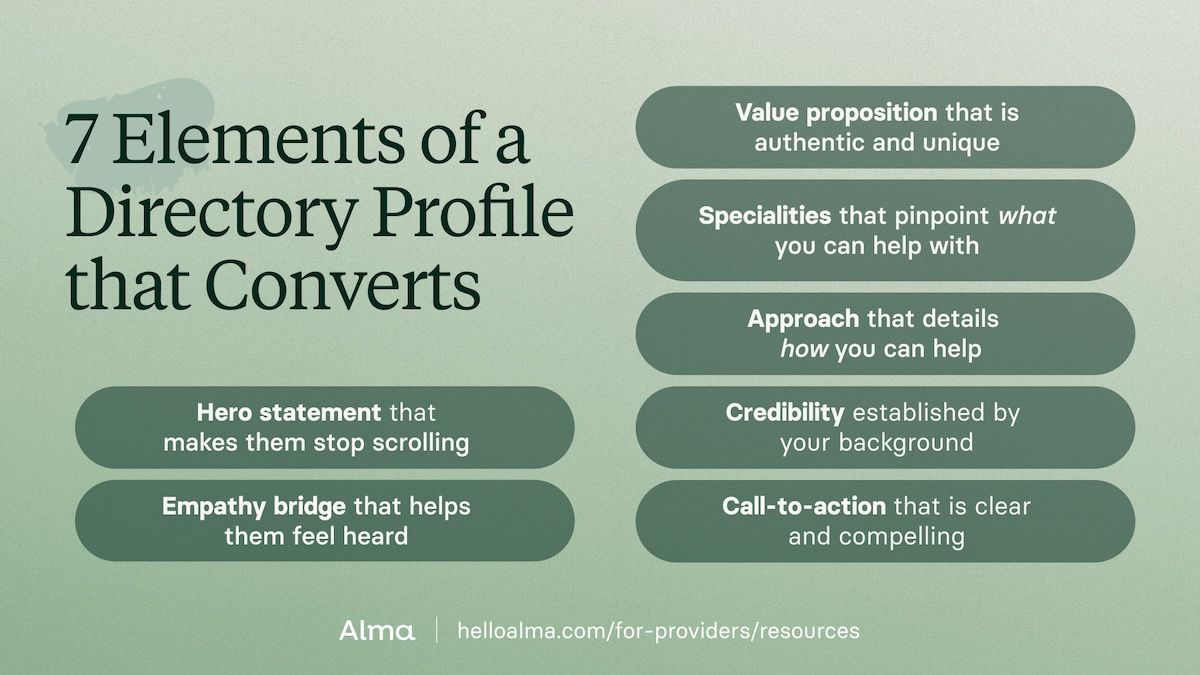
This guide walks through the seven essential elements of building a therapist profile that will resonate with your ideal clients. From crafting a compelling hook, to showing personality, to making it easy for the right people to reach out, these are practical strategies that help clients recognize a therapist who can genuinely help them.
Whether you’re just starting out or looking to refresh a profile after years in practice, the tips below provide actionable insights for crafting a profile that converts.
General Profile-Writing Principles
When a prospective client lands on your profile, you want them to get the immediate sense that you're especially equipped to help them. You also want them to feel seen and validated. Their ideal response: “It's like this therapist jumped into my head, grabbed my thoughts, and put them on paper.” To have this powerful effect, be sure to:
- Keep your ideal client front-and-center. Try to imagine that client into the room with you. What do they want and need to hear? What specific problems are they likely to be facing?
- Use language that resonates. Avoid clinical jargon and aim to connect on a human level. Instead of saying, “I specialize in resolving maladaptive trauma-related cognitions,” you can say, “I help people make sense of what they’ve been through so they can stop feeling stuck and start feeling like themselves again.”
- Highlight your unique qualities. If you browse any directory, you’ll notice that many therapists describe themselves as “warm”, “empathic”, and “non-judgmental.” These are all wonderful traits, but they won’t set you apart from other therapists. Emphasize the unique skills, perspectives, and ideas that make you their ideal therapist.
- Be transparent about rates and insurance. This is essential information for many clients and should be very easy for them to find.
7 Elements of a Profile that Converts
1. Hero Statement
As a general rule of thumb, you don’t want to make prospective clients scroll! They're not going to read paragraph two of your profile if paragraph one doesn't grab them.
That’s where a hero statement comes in. The hero statement should appear in the first one or two sentences of your profile.
Tips for an effective hero statement
- Speak directly to their pain point. Consider why your clients are coming to you, and try to speak directly to that need.
- Convey hope. Let clients know that you have helped many clients, and that they will not feel how they feel now forever.
- Name your niche. This is where you clarify your niche. If they have to scroll to paragraph two to see that you work with perinatal mental health or blended family, they may miss it. Your niche must be front and center.
Examples
If your specialities are anxiety and overthinking...
“If you’re exhausted from constant worrying and second-guessing yourself, you’re not alone. I help anxious adults quiet the noise, feel grounded again, and rebuild trust in themselves.”
If your speciality is perinatal and postpartum mental health...
“Pregnancy and new parenthood can feel overwhelming, but you don’t have to navigate it alone. I support birthing parents through anxiety, mood shifts, and the identity changes that come with this season.”
If your specialties are relationships and boundaries...
“If you’re stuck in the same painful relationship patterns, I help individuals and couples break cycles, communicate clearly, and build relationships that feel safe and connected.”
2. Empathy Bridge
This is where you let prospective clients know their feelings make sense. Many people come in carrying shame, guilt, or low self-worth, and a moment of genuine validation helps them feel seen and understood.
Tips for an effective empathy bridge:
- Use “you” language. Speak directly to the client—“You feel overwhelmed,” “You’re doing your best,” “You’re not sure what to do next.” This creates connection and helps them feel like you’re speaking to them, not about “clients” in general.
- Normalize their experience. Remind them they’re not alone and that many people struggle with similar feelings or situations. Normalizing reduces shame and helps clients feel less “broken” or “different.”
- Avoid jargon or overly clinical terms. Especially early on, stick to simple, human language. Terms like EMDR or CBT can come later. If someone doesn’t know what a term means, they may disconnect from what you’re saying.
Example
“Maybe you've tried to handle things on your own, but the stress keeps building. It's exhausting to feel stuck in the same pattern. You want real change.”
3. Value Proposition
This is where you answer two key questions for prospective clients: What do you want? and How can I help you get there? It’s your chance to briefly introduce who you are, what working with you is like, and what makes your approach different.
General statements like “I work with anxiety, depression, and trauma” won’t help you stand out—nearly every therapist can say that. Instead, focus on what you uniquely offer and how your style or approach helps clients create real change.
Tips for a strong value proposition:
- Describe your style. Be transparent about what it’s like to work with you. For example: “I’m a very direct therapist—I’ll be honest with you and gently call things out when needed. If that feels helpful, great. If it feels overwhelming, we’ll adjust.”
- Use warm, plain-language descriptions. Skip the clinical labels and describe the work in human terms. Instead of “I use CBT,” try something like, “I help you notice the unhelpful thoughts that show up and learn how to shift them so they don’t run the show.”
- Give a small glimpse of your personality. You don’t need a long bio—just one or two details that make you feel like a real person. It could be, “In between chasing my two kids around the house…” or “I’m a big nature lover and often bring those metaphors into sessions.” Sometimes that’s the exact thing that helps a client feel connected enough to reach out.
Example
“Together, we’ll get clear on what’s driving these patterns and build tools that genuinely work in your day-to-day life. I tend to use practical strategies, outside-the-session resources, and a bit of humor. I rely heavily on analogies because they help make complicated things simple—and clients tell me they stick.”
4. Specialties
This is where your niche really shines. After you’ve hooked someone and shown them you understand their experience, you can start getting more specific about your training, areas of focus, and the kinds of clients you’re most passionate about helping. By this point, they’re already engaged—now you help them see that they’ve landed in the right place.
Tips for highlighting your specialties:
- Help your ideal client recognize themselves. Your goal is for someone reading to instantly think, “Yes—this is me.” When your specialty is clear and specific, people who reach out are more likely to work with you because they feel seen from the start.
- Name the specific issues you work with. Whether it’s anxiety, infidelity, men’s issues, military life, relationship struggles, parenting stress—spell it out. Specificity builds trust and helps clients feel understood before they ever meet you.
- Avoid overwhelming them with a long list. Focus on your top three to five specialties. You can still use broader lists for SEO or search filters, but in your profile copy, clarity beats quantity.
Example
Use “I help _____ who struggle with _____ ” statements. This format makes it easy for clients to identify themselves. For example: “I help men who struggle with self-doubt,” or “I help new moms who feel like they’re never doing enough.” It’s direct, validating, and instantly relatable.
5. Approach
This is where you briefly describe how you work. What is it like to be in a session with you? What makes your style or therapeutic approach distinct? Sharing this helps clients imagine themselves in the room with you and shows them what sets you apart from other therapists.
These elements (approach, specialties, credibility) don’t need to appear in a strict order. Once someone has connected with your hero statement, felt validated, and understands what you offer, they’re far more likely to keep reading.
Tips for describing your approach:
- Be brief. Clients want to feel confident that your work is evidence-based, but they don’t need all the details. Share enough to promote understanding without resorting to dense clinical language.
- Explain modalities in simple, human terms. Rather than naming models or techniques clients may not recognize, describe what they do. For example: Instead of, “I help you get unstuck from trauma thinking styles,”you might say, “Trauma can shift how you see yourself, other people, and the world. I help you gently rework those beliefs so life doesn’t feel so scary or overwhelming.” That said, if you use modalities that are well-known or trending, be sure to include them.
- Describe session structure. Many clients have never been to therapy and don’t know what to expect. Give them a sense of the flow: “Do I need to come with a goal?” “Will you guide the conversation?” “How structured is it?” A few grounding details can reduce anxiety and build comfort.
Example
“Using proven methods like EMDR and other evidence-based tools, I help you process difficult experiences and develop healthier ways of relating to yourself and the world around you. Sessions are collaborative, structured enough to give you direction but flexible enough to meet you where you are.”
6. Credibility
This is where you briefly show why you’re qualified to help. Whether it’s a certification, years of experience, a specific training, or even meaningful lived experience—you want to offer clients a concrete reason to trust you. You don’t need to overwhelm them with your full résumé, but you do need to give them something that sets you apart from the intern, associate, or generalist down the street.
Tips for demonstrating credibility:
- Emphasize your experience, training, or credentials. Clients want to know they’re in capable hands. Even a simple statement like “I’ve been doing this work for 12 years” immediately builds confidence.
- Highlight expertise that matters to your niche. If you hold specialized certifications, have completed intensive trainings, or have deep experience with a particular issue, name it, especially if it directly relates to why someone is reaching out.
- Keep it concise and easy to digest. You don’t need to list everything you’ve ever done. A couple of strong, relevant points are enough to build trust. They can always learn more on your website or during the consultation.
Example
“I have over 12 years of experience supporting clients through challenges just like yours. I’m a CSAT, which means I’ve completed extensive, year-long training specifically focused on treating these issues.”
7. Call to Action
Make it as easy as possible for prospective clients to contact you. A clear, visible call-to-action (CTA) on your website—ideally in the top right corner and repeated throughout the page—helps clients reach out without frustration or extra steps. If someone is ready to work with you but has to scroll endlessly to find your contact info, many will give up before they ever hit “send.”
Tips for an effective call to action:
- Make contacting you simple and obvious. Your phone number, email, or contact button should be easy to find.
- Consider offering free consultations. You don’t have to, but know that most therapists do. Offering a free consultation helps clients feel safer reaching out.
- Remove unnecessary barriers. If your contact info is buried, missing, or confusing, you’ll lose clients. Yes, posting a phone number may bring some spam, but accessibility is far more important. Remove friction wherever possible.
Example
“I'm looking forward to chatting with you. Reach out today to schedule a free 15-minute consultation to see if we’re a good fit.”
Consider a Quarterly Refresh
Don't wait until next January to update your profile again. In fact, consider a quarterly update that will allow you to add new details about your practice, mention current or seasonal events that may be impacting your ideal client, or update your language to reflect shifts in how people are talk about the pain points you address.
Clients are savvy consumers. Keeping your profile fresh will send the message that you're open to new clients and can help them navigate the ever-changing challenges they face in their lives.


Written by
Gary Hominick, LPC





Learn More
Build a thriving private practice with Alma
We believe that when clinicians have the support they need, mental health care gets better for everyone.