

How Daylight Saving Time Affects Sleep & Mental Health
“Springing forward” disrupts circadian rhythm and can hit certain individuals especially hard.
If you’ve always suspected that suddenly shifting your life ahead by one hour has an impact on your mental health, science confirms that you’re correct. Read on for the truth about how daylight saving time affects your mind and body—plus helpful strategies to navigate the transition as smoothly as possible.
Daylight saving time and your circadian rhythm
The reason daylight saving time is so disruptive has everything to do with circadian rhythm, which is essentially your body's internal clock. Think of it as a biological GPS that tells every cell in your body when to do what: sleep, wake, release hormones, regulate mood.
This internal clock involves approximately 20,000 neurons, located in something called the suprachiasmatic nucleus, which is in your hypothalamus. Your individual clock is set mainly through light exposure (Walker et al., 2020). Morning light tells your brain “it’s time to wake up and be alert.” Evening darkness signals “it’s time to wind down and produce melatonin.”
But when we mess with clock time, as spring daylight savings time does, we force ourself to ignore those cues—it’s lighter outside when we need to wind down at night, and darker when we need to wake up in the morning.
To say that our bodies and minds don’t like this new scenario is a massive understatement.
How does daylight saving time affect mental health?
The spring transition is particularly brutal because you're losing sleep right off the bat. On average, a person gets 40 minutes less sleep on the Monday after DST begins compared with other nights of the year.
It's not just about feeling tired—the scientific evidence points to acute increases in adverse health consequences.
According to research (Osborne-Christensen, 2022; Heboyan et al., 2019; Rishi et al., 2020; Takahashi, 2025), “springing forward” is associated with a higher incidence of:
- Heart attacks and strokes
- Fatal accidents
- Elevated production of inflammatory markers in response to stress
- Risk of mental health symptoms and negative events
These mental health symptoms and negative events include increased anxiety, stress, depression, and even suicide attempts.
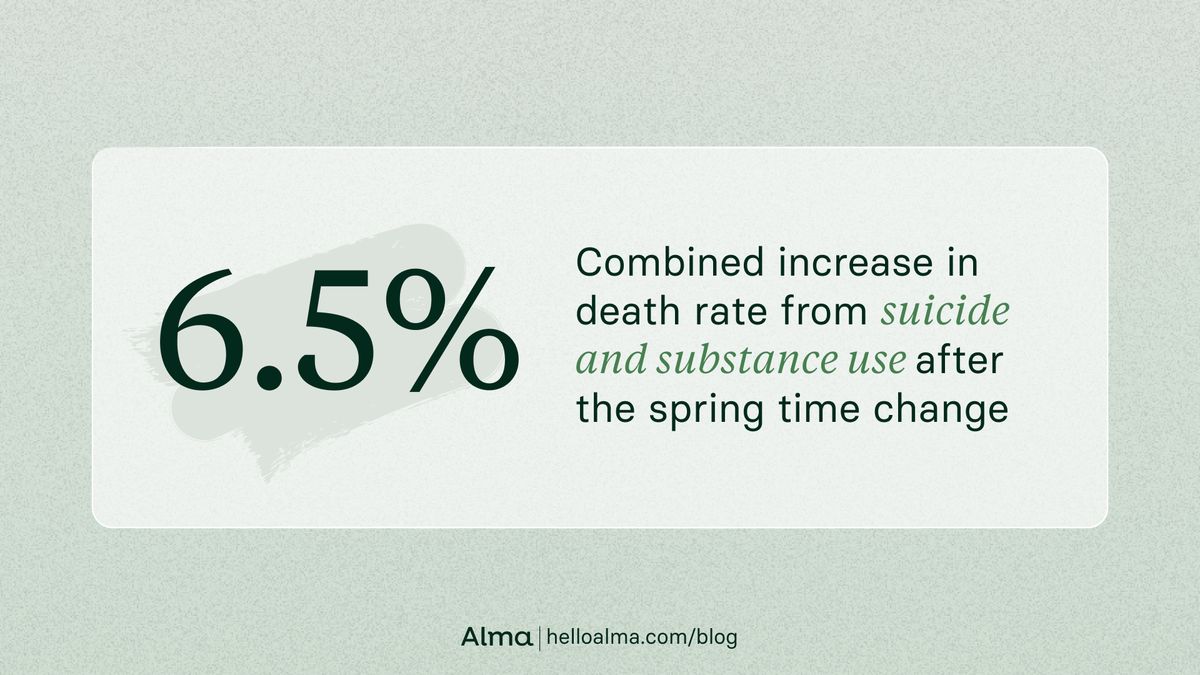
Sleep disruptions during the spring transition have been determined to cause the suicide rate to rise by around 6% and the death rate from suicide and substance abuse combined to increase by around 6.5% directly after the time change
The mechanism for why this occurs is fairly straightforward. When you're sleep deprived, your serotonin (the “happy chemical”) takes a hit. Sunlight is thought to increase serotonin, a mood-lifting hormone; however, in those first days after springing forward, you're waking up in darkness and your body's natural rhythms are completely out of sync (Rishi et al., 2020; Rodriguez, 2020).
Feeling like you may be in crises? Call NAMI's information line (1-800-242-6264, option 4) or the 988 Suicide & Crisis Lifeline. They're available 24/7, and available to everyone.
Who is most affected by daylight saving time changes?
Not everyone struggles equally with the time change. There are specific populations that tend to be particularly vulnerable, and understanding who's most at risk is crucial for targeted intervention (Johnson & Malow, 2022; Walker et al., 2020).
- People with pre-existing mental health conditions face amplified risks. If you're already managing depression or anxiety, the additional circadian disruption can trigger symptom exacerbations that require clinical intervention. The spring transition can be especially rough for folks dealing with mood disorders.
- Teenagers and young adults are naturally “evening types,” making the spring time change particularly difficult for younger workers and students. Their bodies are biologically wired to stay up later and sleep in later; so, forcing them to wake up an hour earlier is working directly against their natural rhythms.
- Shift workers are another highly vulnerable group. These folks are already fighting against their circadian rhythms by working at night. Add in the time change, and you're compounding an already challenging situation.
- Older adults may have their own unique challenges adjusting to the earlier wake time, particularly if they have age-related changes in sleep patterns.
How to cope with daylight saving time (sleep and mental health tips)
So we know that daylight saving time is bad for minds and bodies, but there are some practical things you can actually do to make it better.
1. Gradual Adjustment
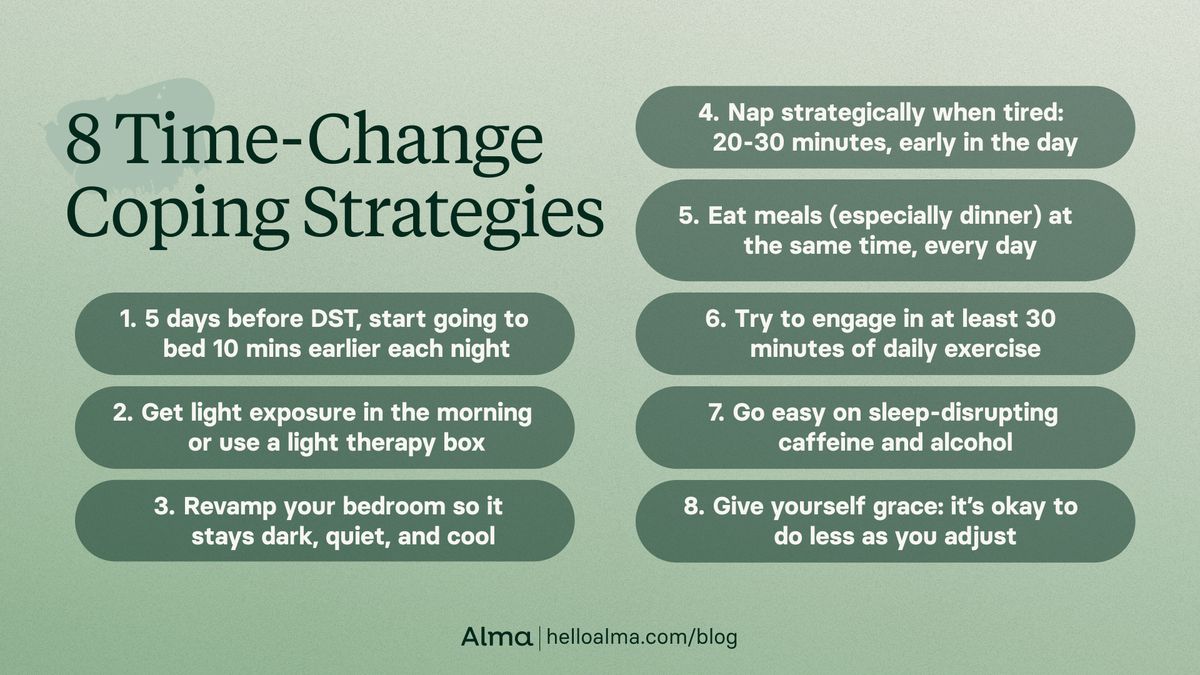
Four or five days before the time change, start going to bed and waking up 10 to 15 minutes earlier each day to help your body slowly adjust. This gradual shift allows your circadian system time to get acclimated rather than forcing a sudden change.
2. Light Exposure
Light is the single most powerful external cue for your circadian system. Research shows that early morning sun exposure is especially helpful. Morning light can help regulate our body's circadian rhythms.
Get outside in the morning, even for just 10-15 minutes. Open your blinds. Sit by a window during breakfast. If natural light is limited, consider using a light therapy box with 10,000 lux exposure for about 15-30 minutes in the morning.
3. Maintain Sleep Hygiene
A healthy bedtime routine can do wonders for your sleep but isn’t easy to put into practice. Good sleep hygiene habits include:
- Going to bed and waking up at the same time every day
- Not watching TV or browsing social media before bed
- Avoiding caffeine and alcohol in the evening
- Not exercising right before bed
- A bedroom environment that supports sleep: cool, dark, and quiet
Your environment may be easier to change that your habits, and it matters more than you might think. Even small amounts of light or noise can delay sleep onset, so the darker and quieter the better. Your body temperature naturally falls in the evening to prepare for sleep, so keeping your bedroom on the cooler side can make a big difference.
4. Strategic Napping
If you're dragging in those first few days after the spring time change, brief naps can help. Keep them under 20-30 minutes and avoid napping too late in the day, as this can interfere with your ability to fall asleep at night. Power naps can boost alertness without significantly disrupting your sleep-wake cycle.
5. Maintain Routine Consistency
Your body craves predictability. Try keeping your mealtimes, especially dinner, consistent with your current schedule. Aim to eat meals, exercise, and engage in daily activities at the same time each day, even after the time shift. Consistency signals to your body when to expect activity and rest, which helps recalibrate your circadian system faster.
6. Physical Activity
Mild, moderate, or intense exercise can alleviate the “down” or “off” feeling that gets intensified by DST. Regular exercise is not only good for physical health, but mental health as well. It can help reduce the sluggishness often felt around the time change and help boost mood and energy levels.
Try to engage in at least 30 minutes of moderate exercise each day, preferably outdoors to combine the benefits of movement with sunlight exposure. Exercise releases endorphins, regulates stress hormones, and helps reset circadian rhythms.
7. Limit Caffeine and Alcohol
Caffeine is a stimulant, and the effects linger in your system longer than you think. The amount of caffeine in an afternoon coffee can affect you for more than 6 hours after consumption.
Skip that late-afternoon coffee and try herbal tea instead. And while alcohol might make you feel sleepy initially, it disrupts sleep quality and can worsen mood the next day.
8. Practice Self-Compassion
Acknowledge that it may be tough for a few days, and give yourself the grace to adjust to the new time instead of criticizing yourself for not being able to keep up as easily.
Adjusting to DST takes time. If you're feeling more tired or irritable than usual, remember that these feelings are temporary and part of the adjustment process.
Are there any upsides to your mental health?
There are some potential benefits to spring daylight saving time once your body adjusts. More evening daylight after you adjust can encourage outdoor activities and social connection, both of which are beneficial for mental health. Sunlight exposure boosts serotonin, which can improve mood and provide a sense of calm (Rodriguez, 2023; Rishi et al., 2020).
The extra evening light also means more opportunities to exercise after work or school, which can help with mood regulation. And for people who struggle with seasonal affective disorder during the dark winter months, the lengthening days that coincide with DST can mark the beginning of relief.
These benefits come after your body adjusts, of course. In those first days and even weeks, the sleep disruption and circadian misalignment are the dominant effects you'll experience.
When to get help for time-change symptoms
If fatigue, poor sleep, or low mood persist for more than two weeks after the time change, it's worth checking in with your primary care provider. Chronic sleep loss affects heart health, immune function, and mental well-being.
For mood changes, especially feelings of sadness or loss of interest in usual activities, your health care provider can screen for underlying conditions that may have been exacerbated by the time change. Treatment might include light therapy, counseling, or short-term medication depending on severity.
Don't try to tough it out; early intervention prevents patterns from becoming entrenched and makes recovery faster.
Take action:
Feel better, around the clock
If life is serving you one challenge after another, a therapist can help you find inner strength and stability. Alma’s provider directory allows you to find a therapist who takes your insurance and fits your unique needs and preferences, so you can start making positive, lasting change.
References:
Coulson, M. (2023, March 9). 7 things to know about daylight saving time. Johns Hopkins Bloomberg School of Public Health. https://publichealth.jhu.edu/2023/7-things-to-know-about-daylight-saving-time
Heboyan, V., et al. (2019). Effects of seasonality and daylight savings time on emergency department visits for mental health disorders. American Journal of Emergency Medicine, 37(8), 1476-1481. https://doi.org/10.1016/j.ajem.2018.10.056
Johnson, K.G., Malow, B.A. (2022). Daylight Saving Time: Neurological and Neuropsychological Implications. Current Sleep Medicine Reports, 8, 86–96. https://doi.org/10.1007/s40675-022-00229-2
Rishi, M. A., et al. (2020). Daylight saving time: An American Academy of Sleep Medicine position statement. Journal of Clinical Sleep Medicine, 16(10), 1781-1784. https://pmc.ncbi.nlm.nih.gov/articles/PMC7954020/
Rodriguez, A. (2020, November 10). How to improve your mood after daylight savings time. CU Denver News. https://news.ucdenver.edu/how-to-improve-your-mood-after-daylight-savings-time/
Osborne-Christensen, E. J. (2022). Saving light, losing lives: How daylight saving time impacts deaths from suicide and substance abuse. Health Economics, 31(52), 40-68. https://doi.org/10.1002/hec.4581
Takahashi, J. S. (2025, March 7). Why daylight saving time may be bad for your brain and health. UT Southwestern Medical Center. https://utswmed.org/medblog/daylight-saving-time-sleep-health/
Walker, W.H., et al. (2020). Circadian rhythm disruption and mental health. Translational Psychiatry, 10, Article 28. https://doi.org/10.1038/s41398-020-0694-0
Related Articles







Feb 26, 2026




Looking for a therapist?
Get tips on finding a therapist who gets you.
By submitting this form, you are agreeing to Alma's privacy policy.