

Tax Season Anxiety: How to Survive the Stress and File on Time
If tax season fills you with dread, it’s not because you’re “bad at money.” Confusing forms and looming penalties can trigger insecurity.
If your chest gets tight when you sit down to look at tax forms or your mind goes down a rabbit hole of imagining worst-case scenarios (fines!! jail!!), you’re one of millions of people who dread April 15th.
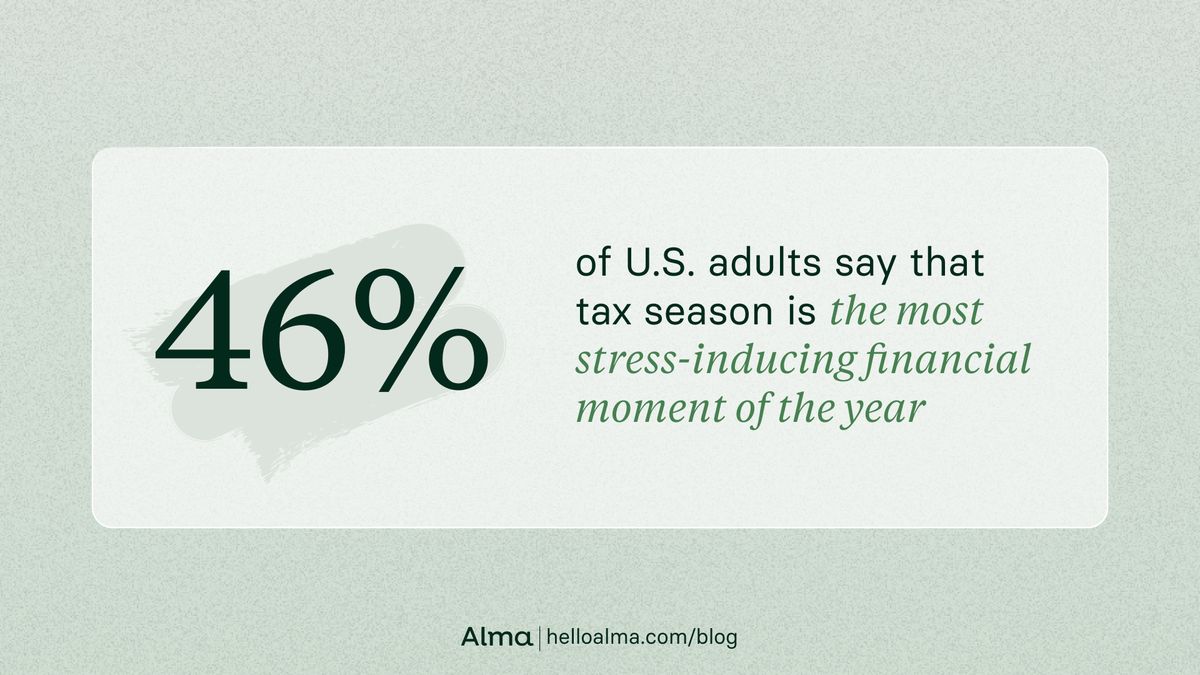
Financial stress is incredibly common (affecting around 77% of U.S. adults), and tax season tends to amplify it. A recent survey found that 46% of U.S adults say that tax season is the most stress-inducing financial moment of the year.
Read on to learn more about tax season stress, the psychology behind why IRS forms are so stressful, and 8 therapist-recommended coping skills for tax anxiety.
What is tax anxiety?
Tax anxiety refers to the intense stress associated with filing taxes, owing money, or facing consequences. It isn’t a formal diagnosis (there’s no such thing as tax anxiety disorder), but it’s a very real mix of emotional, cognitive, and physical symptoms.
According to licensed clinical social worker Ruschelle Khanna, “symptoms” of tax anxiety include:
- Procrastination and avoidance
- Catastrophic thinking and imagining worst-case scenarios
- Irritability and mood swings
- Shame
- Self-criticism
- Trouble sleeping due to financial stress
- Physical symptoms like chest tightness, headaches, stomach discomfort, and muscle tension
Why tax season triggers so much anxiety
If you’re wondering, “Why do I avoid doing my taxes?” or “Why do taxes make me so stressed out?” Here are some common reasons why tax season is so anxiety-inducing.
Facing your financial reality
“Tax season forces people to confront their full financial picture all at once, including income, spending, debt, and savings, which many people actively avoid throughout the rest of the year,” says Jessica Reis, a licensed marriage and family therapist and certified financial therapist.
This can be especially hard if money’s already tight. For many people, tax season brings up fear about owing money, not having enough saved, or realizing their financial situation isn’t where they hoped it would be.
Unavoidable uncertainty
Tax documents are technical and full of language we just don’t get. “When we don’t understand something, the brain interprets it as a potential threat,” says Khanna. “Ambiguity activates uncertainty—and uncertainty is one of anxiety’s favorite fuels.”
Not to mention, most of us never receive any formal education teaching us how taxes work, Reis says. Without learning how to do taxes, it’s no wonder we have overwhelming tax filing anxiety.
Fear of making mistakes
It’s common to have anxiety about getting something wrong since tax forms involve so many numbers and rules, Reis says. This fear is often worse for freelancers or small business owners who don’t have straightforward taxes.
“From a therapeutic lens, this often shows up as catastrophic thinking, a pattern where the mind jumps straight to worst-case scenarios even when the actual likelihood of serious consequences is low,” says Reis.
Anxiety around authority and punishment
“Taxes are tied to government systems, penalties, and potential audits,” says Khanna. “For some, this unconsciously activates fears around being judged, punished, or getting in trouble. Even responsible adults can feel like they’re back in school awaiting a grade.”
Real talk: the chances of being audited are low, but many experience audit anxiety. “The idea of an audit can feel like being put under a microscope, and it often triggers a fear of being ‘caught’ doing something wrong, even when there is no wrongdoing at all,” says Reis.
Avoidance and procrastination
Whether life got in the way or your anxiety caused you to delay, procrastination often backfires.
“Avoidance increases stress over time,” Khanna says. “As the deadline approaches, urgency rises, and the nervous system shifts into fight-or-flight mode.” This can make it even harder to get started, creating a vicious cycle.
Inherited money trauma
“Many of our reactions to financial stress did not start with us and were either patterns taught in the home as a child,” Khanna says. Growing up around financial instability or shame can shape how your nervous system responds to money in adulthood.
When tax anxiety signals a deeper issue
If you only experience anxiety and avoidance symptoms during tax season, your anxiety is likely situational and doesn’t necessarily signal a broader mental health condition, like an anxiety disorder or attention-deficit/hyperactivity disorder (ADHD).
However, it may be worth talking to a mental health therapist if:
- You’re having intense physical symptoms or panic attacks
- You have difficult-to-control anxiety year-round – related to finances or not
- You have trouble starting or completing tasks or focusing in general
- You frequently experience shame or self-criticism
How to deal with tax anxiety this filing season
Now that you know what fuels anxiety about taxes, here are specific tips to manage tax anxiety, both in terms of managing your mental health and actually getting the paperwork done.
First things first: Soothe tax-related anxiety
1. Reality-check catastrophic thoughts
If you’re filled with IRS anxiety, spiraling and imagining worst-case scenarios, pause and take a look at these thoughts so you can reframe them.
For example, maybe you’re imagining a worst-case scenario about going to jail because you messed up on your forms. Khanna suggests asking yourself, “What is actually likely?”
“Most tax mistakes are fixable,” she says. “The IRS sends letters before levying consequences. Replacing imagined disaster with factual process reduces fear.”
2. Take a minute to name emotions
When you’re having tax season anxiety, remember there are probably other emotions behind the anxiety.
“Pause and conduct a brief emotional check-in with yourself,” Reis says. “Are you experiencing shame about what you earned? Fear about what you might owe? Resentment toward the process itself?”
When you label what you feel, it helps your “thinking brain” take the lead instead of the “emotional brain,” Reis explains. Even something as simple as labeling can help lower the intensity of what you’re feeling.
3. Regulate your nervous system
“Financial stress manifests somatically as much as it does cognitively, and your body often knows you are anxious before your mind does,” Reis says. For example, you might feel shallow breathing, chest tightness, or muscle tension.
Don’t push through; listen to your body. Take a break from what you’re doing and regulate your nervous system. Physical movement is a great way to calm your mind. Try stretching, going for a run, or taking a walk around the block.
You can also try breathing exercises to get out of fight-or-flight mode. Reis recommends box breathing, where you visualize breathing along each side of a square. You do this by:
- Inhaling for 4
- Holding for 4
- Exhaling for 4
- Holding for 4
- Repeating until you feel more regulated
4. Filing jointly? Talk to your partner
Work on approaching tax season as a team. “If you are filing jointly or sharing finances, take a moment to have an honest, non-judgmental conversation before you sit down to file,” Reis says. “Money is one of the most emotionally charged topics in relationships, and tax season has a way of bringing unspoken dynamics to the surface.”
Resentment around money and financial work can fester if things remain unsaid. Try the “listening chair” exercise from Gottman couple’s therapy: when it’s your turn in the chair, you get to express what you're thinking and feeling, and your partner’s only task is to reflect or repeat back what you’re saying in their own words. Then switch places.
Getting practical: tackle tax-related tasks
5. Break the work into micro-steps
Wondering how to start taxes when you feel overwhelmed?Instead of adding “do taxes” to your to-do list (which we already know is super anxiety-inducing), Khanna suggests breaking it down into microsteps. “Small, concrete tasks calm the brain because they feel achievable,” she says. “Progress reduces anxiety.”
Create a structured checklist with steps. Reis says these steps might include:
- Gather receipts
- Collect W-2s
- Log in to your filing platform
- Complete one section at a time
6. Block time on your schedule
Khanna recommends choosing a specific time and date to work on your tax checklist. Containing the task can help prevent it from taking up space on other days when you wonder whether you might do taxes today.
As with any undesirable task, getting started is often the hardest part. Once you begin, you might realize it’s not as terrible as you thought it would be. As a bonus, you can pair the process with a comforting element, like a favorite beverage or calming music, Reis says.
7. Get professional or digital support
Working with a tax professional like a certified public accountant (CPA) can make tax season infinitely more bearable. “Many people carry a belief that they ‘should' be able to handle their taxes on their own, but that expectation often adds unnecessary pressure to an already stressful experience,” Reis says. If cost is a concern, you can find low-cost or free tax return preparation services here to see if you qualify.
Can’t afford professional help? There are many user-friendly tools available online to help you make sense of your tax forms. Reis suggests:
- TurboTax
- H&R Block
- FreeTaxUSA
- Cash App Taxes
If navigating filing is what stresses you out the most, these platforms walk you through each step, Reis says.
8. Plan early for the next year
To experience less tax filing anxiety next year, start planning early. If you’re a small business owner or freelancer, Reis suggests using an app like Keeper to track deductions throughout the year so that tax season feels much less chaotic and rushed. “Even something as simple as keeping a dedicated folder for all your tax-related documents as they come in, whether on your computer or in a drawer, can cut down on that feeling of anxiety when it is time to file,” she adds.
You don’t have to do this alone
“If tax season makes you tense, avoidant, or ashamed, there is nothing ‘wrong’ with you,” Khanna says. “You’re not bad at being an adult. You’re navigating a complex system that didn't start with you, and that deserves patience for yourself, not judgment.”
We can easily convince ourselves that we don’t need or deserve help. Yet, experience tells us that, as soon as we do have someone we trust in our corner, everything can change for the better.
If general advice isn’t working for you, reach out to someone who can give you personal support, whether that’s a tax prep specialist or a mental health therapist who can help you manage anxiety in any and all areas of your life.
Take action:
Break free from anxiety
Working with a therapist can help you get to the root of your money worries and find a deep sense of security that’s independent of financial status. At the same time, managing anxiety can allow you to reduce procrastination and start planning for a better financial future. Get started by browsing our nationwide directory for a therapist who feels right for you.
Related Articles




Feb 24, 2026


Looking for a therapist?
Get tips on finding a therapist who gets you.
By submitting this form, you are agreeing to Alma's privacy policy.