Articles
Data Insights: Why Some Clients Cut Therapy Short & Others Stay Longer


Most clients who seek outpatient therapy through the Alma platform attend somewhere between 10 and 20 sessions. They spend the first few sessions building rapport with their therapist and establishing goals. Then they focus on doing the work for several months. As they experience positive changes, they decide together with their therapist when to wind down.
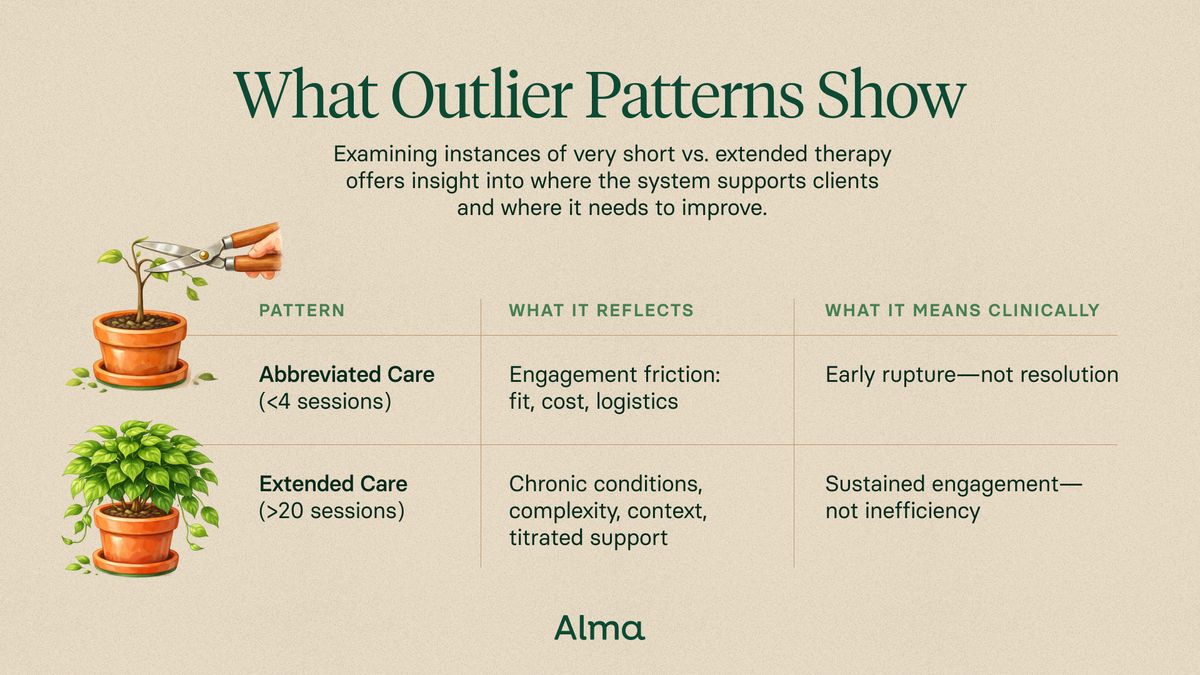
Of course, not every client follows this pattern — a significant number of clients either leave after just one to three sessions or stay engaged in care for several months.
Payers often assume that short-term care equals efficient care, and that extended care is a red flag, signaling clinically inappropriate care or overutilization. Clinicians know that these two scenarios are very different and tell a much more complex, human story.
As Alma’s VP of Clinical, I recently led our Clinical Quality team in learning more about these outliers. The team surveyed clients who ended care early and facilitated focus groups with clinicians who routinely work with long-term clients. Our findings shed new light on what outlier patterns really mean in therapy — and how we can support both clients and providers more effectively.
Why clients leave after a few sessions
Across 114 clients who ended care within the first three sessions, only 17% said they had actually met their goals, and 48% said they did not attend as many sessions as they needed. The majority of these clients reported cutting therapy short for one of two reasons.
Therapist fit: 46% said the therapist wasn’t the right match for them.
Cost concerns: 34% said that affordability or lack of clarity regarding insurance coverage was their main factor for stopping.
It’s clear that the first 1–3 sessions deeply shape engagement. If there’s a mismatch in terms of a provider’s specialty and a client’s needs —or if the cost of therapy is too high or unclear — it can prevent people from getting the care they need.
Why clients stay in long-term treatment
When we asked clinicians about clients who stayed on for 20 or more sessions, we heard a remarkably consistent message: this long-term care was clinically appropriate. The myth that clients stay in therapy “just to have someone to talk to” wasn’t reflected in our research.
Complex or chronic concerns: When clinicians were asked about long-term care, they described working with individuals facing chronic conditions, trauma histories, unstable environments, major transitions, or minimal external support. In these cases, longer-term therapy functions much like ongoing medical care:
- Stabilizing chronic patterns
- Preventing relapse
- Providing additional scaffolding during destabilizing periods
Supporting nonlinear progression: Across contexts, healing is often non-linear. This is certainly true in the field of mental health. The clinicians we spoke to described long-term work with clients as a cycle of:
- Consolidation
- Growth
- Setbacks
- Reorientation
For many, long-term therapy includes gradually reducing frequency as clients strengthen internal resources. Clinicians emphasized this as an ethical and intentional part of care rather than codependency or overutilization.
4 Key takeaways for providers
1. Don’t underestimate what’s at stake in the first two to three sessions.
Clients make fast decisions about whether therapy feels safe, relevant, and sustainable. Small adjustments — clear agenda setting, transparent expectations, and early check-ins about fit — can improve engagement dramatically.
2. Documenting long-term care is an opportunity to tell the true story.
Comprehensive and detailed progress notes that show the “golden thread,” help payers understand the value of ongoing care. The clinical narrative for extended care often includes:
- Chronic or cyclical symptoms
- Environmental demands
- Skill-building
- Processing trauma
- Functioning and role performance
3. Long-term therapy does not equal inefficient therapy.
Healing does not follow a linear or time-limited curve. Some clients need consistent therapeutic relationships to maintain gains, just like some medical patients need ongoing specialist care.
4. Early dropout is not a failure of the clinician.
More often than not, it’s an invitation to strengthen support around:
- Matching expertise or lived experience to client needs
- Clarity around benefits and accessing affordable sessions
- Self-scheduling and availability of virtual care
- A special focus on early alliance-building
How we’re helping at Alma
Our findings point to two areas where we're focused on doing better at Alma.
Early engagement: We're investing in smarter upfront matching that accounts for both clinical needs and personal fit, clearer communication about benefits and out-of-pocket costs before a first appointment is ever booked, and earlier check-ins that make it easier to course-correct or rematch when the fit isn't right. The goal is to remove the friction that keeps people from getting to the work that matters.
Better support for clinicians working with long-term clients: These providers are doing some of the most complex, high-stakes care in the system — and they often have to fight to justify it. We're building tools to help clinicians document progress in ways that tell a fuller clinical story, one that captures the nonlinear nature of healing, the real-world pressures clients are navigating, and the functional gains that come from sustained therapeutic relationships.
We're also working to educate payers using the kind of real clinician narratives that make the case for long-term care in human, not bureaucratic, terms.


Written by
Elisabeth Morray, PhD





Learn More
Build a thriving private practice with Alma
We believe that when clinicians have the support they need, mental health care gets better for everyone.