
Limerence vs. Love: How to Tell the Difference
Limerence is a felt sense that lives on a spectrum, ranging from mild infatuation to more extreme behaviors.
Limerence is often mistaken for that early, infatuation phase of love: when your mind keeps drifting back to the person you’re falling for. You might find yourself daydreaming, imagining a fairytale romance, not being able to sleep from excitement, or replaying interactions to remember the leap in your heart when they looked at you a certain way. But limerence goes further than infatuation, to the point where your expectations can lose touch with reality. Like the main character in the movie 500 Days of Summer whose life transforms into a musical with birds soaring overhead, limerence almost always leads to disappointment.
Limerence is defined as a state of intense romantic obsession involving mental preoccupation and emotional volatility. It can lead to problems if we want to build a healthy, interdependent relationship. However, it’s not a formal diagnosis. Like other emotions, it’s a felt sense that lives on a spectrum, ranging from mild infatuation to more extreme behaviors.
If you feel like you can’t stop thinking about someone and it’s starting to disrupt your life, remember that limerence has something to tell us, often about what the deeper, more vulnerable parts inside of us are needing.
What limerence is and how it feels
Psychologist Dorothy Tennov coined the term limerence in the 1980s while researching the early stages of romantic love. She noticed that infatuation could be damaging when it reached levels of involuntary, intense obsession that disrupted healthy relationship-building. Oftentimes, limerence involves idealization and emotional dependency, which makes it easy to swing between feeling joy or despair depending on how you’re treated (Willmot & Bentley (2015).
Common signs of limerence include:
- Obsessive preoccupation where your thoughts return to them constantly, even when you're trying to focus on something else
- Emotional dependency and feeling that you’re incomplete without them
- Anxiety and self-consciousness about how they see you or whether they like you
- Idealization of the person as perfect and completely able to meet your needs
- Fear of rejection and sensitivity to signs of possible rejection
- Sudden emotional changes depending on how they treat you
- Neglecting yourself for their sake, including losing sleep or normal activities
These features of limerence have a neurological basis. Love itself is an intense experience that causes neurobiological and chemical changes in the brain. Levels of the reward neurotransmitter dopamine surge and cause a sense of euphoria, and serotonin spikes make it hard to stay regulated. The bonding hormone oxytocin is released, making it hard to be apart from the person for very long, even in our thoughts.
But with limerence, these natural brain changes start to take on qualities similar to addiction, including intrusive thoughts or withdrawal symptoms (Wyant, 2021). You might find yourself constantly checking your texts to see if they’ve responded, and feeling anguish if they haven’t. Or, you might monitor their social media pages and dissect their posts for clues about how they feel about you, vacillating between exhilaration and feeling crushed.
In rare cases, extreme levels of limerence have been tied to stalking and violence, as in the case of individuals who stalk or threaten celebrities. But for most, limerence looks much less dramatic. You might have well-meaning friends start telling you, “You haven’t been acting yourself lately,” or “You seem obsessed with this person.” Their feedback can feel critical, pessimistic, or unsupportive. But it can also be a cue to go inwards to understand your inner world more deeply.
Limerence and attachment wounds
Research has found that the strongest emotional drivers of limerence tend to be feelings of sadness and loneliness. At intense levels, it can cause painful amounts of anxiety, uncertainty, and self-doubt. It’s commonly believed that these reactions originate from an anxious attachment style (Evens et al, 2026).
Attachment styles can differ across our relationships. You might feel secure and accepted by your friends, and hold a nuanced view of your parents’ strengths and weaknesses. But romantic intimacy often comes with higher stakes. Oftentimes, it triggers attachment wounds we’ve experienced in relationships of all kinds that were hurtful, neglectful, or damaged our self-worth. These relational traumas often come with a strong fear of abandonment or intrusive anxiety (Zagaria et al, 2024).
Relationship trauma can lead you to believe that “I am incomplete on my own,” “Something’s wrong with me,” or “True love will make me whole”. The need for the other person makes it easy to feel deeply hurt by any perceived rejections. You might be reminded of past abandonment, such as by caregivers in childhood who didn’t meet your essential needs.
In the evidence-based therapy Internal Family Systems (IFS), parts of ourselves that are desperate for love are often seen as holding trauma burdens. They’re often protected by more defensive parts of us that are working hard to make sure we aren’t hurt again – whether through keeping us isolated, or looking to others for rescue.
Limerence could be coming from a wounded part that’s longing for love and emotional safety. Or limerence could come from a protective part that’s determined to ignore the aspects of someone that aren’t ideal, to protect you from the painful truth that they won’t always be able to meet your needs.
How to stop limerence
According to relationship researchers John and Julie Gottman, limerence can sometimes transform into healthy love. This is because love exists on a spectrum, with obsession on one end, and indifference on the other. Healthy love lies somewhere in the middle, and naturally fluctuates depending on the relationship season and context. A realistic goal is to move toward that middle space by patiently building trust and vulnerability with each other.
Here are four strategies to consider:
1. Build internal boundaries
If you sense that limerence is one-sided, an important step is to build internal boundaries. You might ask a friend to hold you accountable to not obsessively check your texts, or choose to do a useful, hands-on activity when the urge to daydream comes on. These behavior changes can be easier to do than trying to force your feelings to change.
2. Build boundaries within the relationship
When limerence happens in a dating relationship, the goal is to build interdependence and emotional boundaries with each other. This often looks like practicing mindfulness of where they end and you begin to avoid enmeshment. So, if your partner isn’t feeling well or is in a low mood, emotional boundaries look like soothing fears of having done something wrong yourself, and focusing on how you can support them.
3. See the good and the bad
Interdependence also looks like staying realistic about their strengths and growth areas. It’s natural during a honeymoon phase to focus on your loved one’s attractive qualities, and tune out concerns. Transforming limerence into love requires acknowledging their flaws while soothing potential disappointment, remembering that these feelings are likely a reflection of your deeper attachment needs, and not a mark on the relationship.
4. Don’t settle for less than mutual love
Being seen, accepted, and pursued by your partner can help you build more secure attachment with yourself and others. This organic process reflects how inner healing often happens through relationships, not because we’re idealizing someone, but because we’re building trust and safety together in real time. It’s possible that you will still feel more whole and complete, but this will be a byproduct of an authentic connection that comes with moments of healthy conflict and repair.
How therapy can help address limerence
A few types of therapy can be particularly helpful for working through limerence that’s disrupting your life.
Internal Family Systems (IFS) is a top one to consider. An IFS-trained therapist will guide you in getting to know and befriend inner parts, including ones that have been working tirelessly to keep you safe, and wounded ones carrying trauma. You learn to access the “8 C’s” of your authentic self: calm, confidence, creativity, connectedness, curiosity, clarity, courage, and compassion.
Questions that an IFS therapist might ask about limerence:
- When you notice the limerence come up, where do you feel it in your body? How does your curious, compassionate self feel toward this part?
- What is the limerence protecting you from? What is it afraid will happen if it stops doing what it’s doing?
- What does the limerent part of you have to say about what it truly needs?
Cognitive Behavioral Therapy can also be helpful for changing obsessive thoughts and behaviors. You learn to redirect preoccupied thoughts, replace idealization with realistic perspectives, and create routines that build your sense of self-worth.
Attachment-Based Therapy is a general therapeutic approach that can help you understand the origins of your attachment style and wounds, soothe triggers and regulate strong emotions, and practice building interdependence in your relationships.
Limerence can be a disorienting and painful experience, but it also carries a quiet invitation: to turn inward and tend to what your inner world is asking for, and begin building a relationship with yourself that makes healthy love possible.
References:
Evans, C., Panton, S. O., Strawson, W. H., Floyd, E., Kellett, S., & Poerio, G. L. (2026). Love, longing and obsession: Features, correlates, comorbidities, and real-time cognitive-affective dynamics of limerence. Acta Psychologica, 267, 107043. Link
Willmott, L., & Bentley, E. (2015). Exploring the lived-experience of limerence: a journey toward authenticity. The Qualitative Report, 20(1), 20-38. Link
Wyant, B. E. (2021). Treatment of limerence using a cognitive behavioral approach: A case study. Journal of patient experience, 8, 23743735211060812. Link
Zagaria, A., Baggio, T., Rodella, L., & Leto, K. (2024). Toward a definition of Attachment Trauma: integrating attachment and trauma studies. European Journal of Trauma & Dissociation, 8(3), 100416. Link
ABOUT THE AUTHOR
Marian Ting, LMFT, is a licensed therapist and writer specializing in trauma, mood disorders, and depth-oriented approaches to mental health. Drawing from her practice across community mental health, university counseling, and group practice settings, she translates clinical insights into content that is accessible, compassionate, and grounded in the realities of years in the therapy room.
Marian writes from both professional expertise and lived experience navigating her own mental health journey, which informs the honesty and warmth of her work. She is passionate about making mental health knowledge empowering for clients and clinicians alike. Marian is also an advocate for the healing potential of psychedelic-assisted therapies and increasing access for underserved communities to this transformative medicine.
Common Questions
What is limerence?
Limerence is a state of intense romantic obsession involving mental preoccupation and emotional volatility. It goes beyond ordinary infatuation to the point where your expectations can lose touch with reality. Limerence isn't a formal clinical diagnosis. It's a felt experience that exists on a spectrum, from mild infatuation to more extreme, disruptive behavior.
What's the difference between limerence and love?
Limerence involves obsessive, intrusive thoughts, idealizing the other person as perfect, and emotions that swing based on how they treat you. According to relationship experts John and Julie Gottman (founders of Gottman Method couples therapy), limerence and love exist on the same spectrum of feelings and behaviors. But healthy love is calmer, grounded in a realistic view of the other person, and grows steadily through mutual trust and regard.
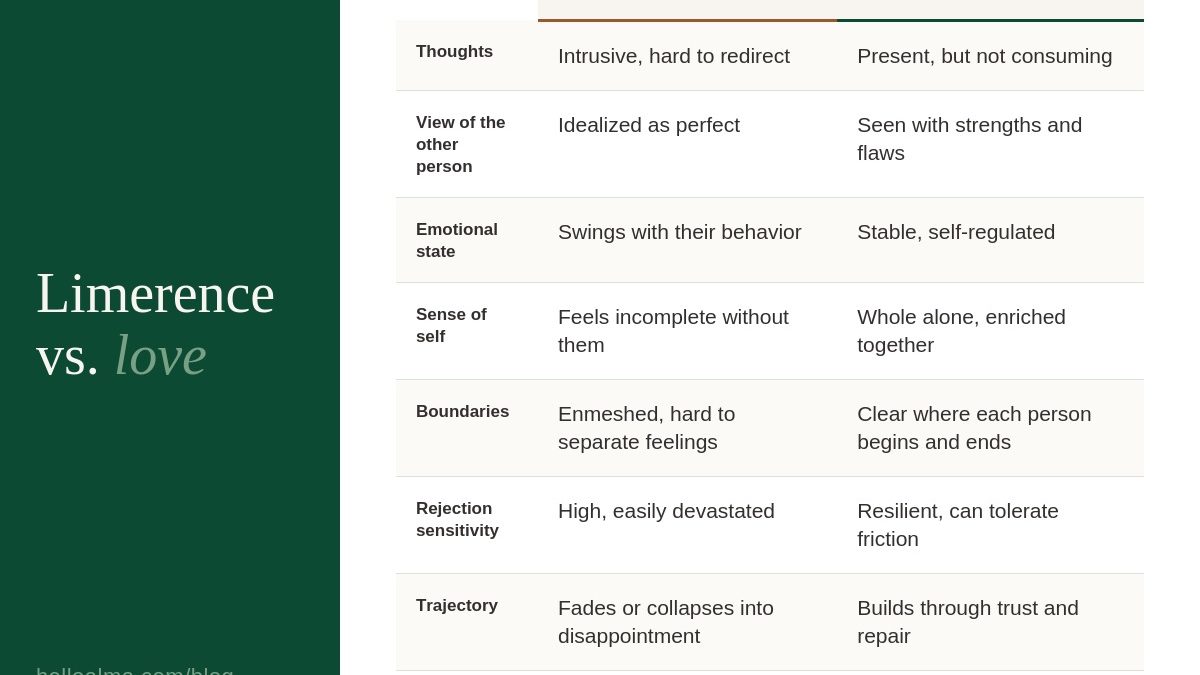
Here's how the two compare across seven key dimensions:
Thoughts
Limerence: Intrusive, hard to redirect
Healthy love: Present, but not consuming
View of the other person
Limerence: Idealized as perfect
Healthy love: Seen with strengths and flaws
Emotional state
Limerence: Swings with their behavior
Healthy love: Stable, self-regulated
Sense of self
Limerence: Feels incomplete without them
Healthy love: Whole alone, enriched together
Boundaries
Limerence: Enmeshed, hard to separate feelings
Healthy love: Clear where each person begins and ends
Rejection sensitivity
Limerence: High, easily devastated
Healthy love: Resilient, can tolerate frictionTrajectory
Relationship trajectory
Limerence: Fades or collapses into disappointment
Healthy love: Builds through trust and repair
What are the signs of limerence?
Common signs of limerence include:
- Obsessive preoccupation — thoughts that return to the person constantly, even when you're trying to focus elsewhere
- Emotional dependency and feeling incomplete without them
- Anxiety about how they see you or whether they like you
- Idealizing the person as perfect and able to meet all your needs
- Fear of rejection and heightened sensitivity to signs of it
- Sudden emotional shifts depending on how they treat you
- Neglecting your own needs, sleep, or activities for their sake
Why do people experience limerence?
Research points to sadness and loneliness as the strongest emotional drivers of limerence, and it's commonly linked to an anxious attachment style. Romantic intimacy carries higher stakes than other relationships, and it can trigger attachment wounds from past relationships — including childhood experiences with caregivers who didn't meet essential needs — leading to beliefs like "I am incomplete on my own" or "true love will make me whole."
Who coined the term "limerence"?
Psychologist Dorothy Tennov coined the term limerence in the 1980s while researching the early stages of romantic love. She observed that infatuation could become damaging once it reached a level of involuntary, intense obsession that disrupted healthy relationship-building.
Is there a biological explanation for limerence?
Yes. Falling in love causes real neurobiological changes — surging dopamine creates euphoria, spiking serotonin makes it harder to stay emotionally regulated, and oxytocin release makes it difficult to be apart from the person, even in thought. With limerence, these normal chemical shifts intensify to resemble addiction, including intrusive thoughts and withdrawal-like symptoms such as anxiously checking texts or social media for signs of how the person feels.
Can limerence turn into healthy love?
Yes. According to John and Julie Gottman, limerence can transform into healthy love once the initial romantic obsession naturally fades. Since love exists on a spectrum between obsession and indifference, moving toward the healthy middle ground happens by patiently building trust and vulnerability with each other over time.
How can I stop limerence or manage it?
A few approaches can help:
- Build internal boundaries — for example, asking a friend to hold you accountable for not obsessively checking texts, or redirecting the urge to daydream into a hands-on activity.
- Practice mindfulness of boundaries in the relationship — knowing where you end and your partner begins helps prevent enmeshment.
- Stay realistic about their strengths and flaws — rather than idealizing them, acknowledge imperfections while managing your own disappointment.
- Consider therapy — Internal Family Systems (IFS), Cognitive Behavioral Therapy (CBT), and Attachment-Based Therapy can all help address the underlying patterns driving limerence.
Is limerence dangerous?
In rare, extreme cases, limerence has been associated with stalking or violence — for example, in cases involving obsessive fixation on celebrities. For most people, though, limerence looks far less dramatic, often showing up simply as friends noticing a change in behavior or commenting that someone seems "obsessed."
What kind of therapy helps with limerence?
Three approaches are especially useful:
- Internal Family Systems (IFS) — helps you get to know the "parts" of yourself involved in limerence, including protective parts and wounded parts carrying trauma, while building access to your authentic self.
- Cognitive Behavioral Therapy (CBT) — helps redirect obsessive thoughts, replace idealization with realistic perspectives, and build routines that support self-worth.
- Attachment-Based Therapy — helps you understand the origins of your attachment style and wounds, regulate emotional triggers, and practice interdependence in relationships.
Related Articles



Jul 13, 2026


Looking for a therapist?
Get tips on finding a therapist who gets you.
By subscribing to emails from Alma, you are agreeing to Alma's privacy policy.