

How to Reset Your Digital Boundaries in 2026
Screens are everywhere—but constant connectivity can take a toll. Here’s how to reset digital boundaries in a way that actually feels doable.
How often do you pick up your phone to check just one thing and suddenly realize you’ve been scrolling for forty-five minutes? Or promise yourself you'll stop working at 6 PM, but there you are at 7:30 answering yet another email? When you finally look up, you might feel disoriented and frustrated—more of your precious time has gone down the digital drain.
There’s no better time than now to pause and ask yourself a key question: Are your digital habits actually serving your values? Not the values you think you should have, or the ones that look good on Instagram stories, but the real, honest-to-goodness things that matter above all else. For most people, the answer is likely to be a resounding “no.”
The solution: digital boundaries. Digital boundaries are intentional limits you set around when, how, and why you use technology to protect your time, attention, and mental health. They not only protect you from mindless scrolling and overwork, they help you create space for the people and activities that matter most to you.
If you don’t have digital boundaries, we’re here to make a strong case for why they matter, and to help you set boundaries that you’ll actually want to stick to.
Digital boundaries and mental health
The most obvious reason for setting digital boundaries is that it will give you more agency over your time. As clinicians, we also see two evidence-based reasons for setting digital boundaries for mental health:
- To combat loneliness, which poses serious risks to health and happiness
- To guard against phone addiction, which is very real
Lack of digital boundaries can contribute to loneliness
Social media and other forms of digital communication (text, email, etc.) were supposed to keep us “connected.” In reality, they’ve contributed significantly to an epidemic of loneliness. Young adults experience some of the highest rates of loneliness, despite being the most digitally connected generation in history (U.S. Surgeon General, 2023).
Loneliness has serious health implications:
- Social isolation is associated with a 29% increased risk of heart disease, 32% increased risk of stroke, and higher rates of anxiety, depression, and dementia.
- Half of U.S. adults report experiencing loneliness, and only 39% say they feel very connected to others emotionally.
- Lacking social connection can increase the risk of premature death as much as smoking up to 15 cigarettes daily.
One study uncovered a vicious cycle: lonely people actively engage with others on social media, but this use actually makes loneliness worse. Why? The lack of fulfillment from online interactions—compared to face-to-face contact—doesn’t result in meaningful connection (Roberts et al., 2024).
Lack of digital boundaries can contribute to phone addiction
Research suggests that cell-phone addiction is a genuine behavioral addiction (De-Sola Gutiérrez et al., 2016) that leads to many of the same symptoms and effects as substance addiction, including:
- Loss of control
- Tolerance
- Withdrawal
- Craving
- Interference with daily activities
- Sleep disturbances
- Anxiety
- Stress
If late-night scrolling is stopping you from getting enough rest, if you find yourself checking your phone instead of giving your full attention to your partner or kids, if you can’t stop yourself from reaching your phone first thing in the morning, these are all reasons to take a closer look at your phone use.
7 Therapist recommended digital boundaries
Your ideal digital boundaries will be personal to you, but we’ve found that the following research-informed ideas can make a big difference. There’s a lot here—consider printing this article out and circling the ones you’d like to try.
1. Set digital boundaries at work
Our “always on” work culture can rob you of time you might otherwise devote to your personal priorities. To contain work hours, set digital boundaries with work messages:
- Set specific times when you’re available for work communications and stick to them.
- Turn off work email notifications at the end of your workday.
- Remove work apps from your phone entirely.
- Set an auto-reply that says you check emails during specific hours.
2. Set email boundaries
Email deserves special attention because it’s often the biggest boundary violator.
- Check email at set times only (morning, midday, end of workday).
- Delete the email app from your phone if possible.
- Use the “schedule send” feature to send emails during work hours only.
Pro tip: Practice the “two-minute rule.” If it takes less than two minutes, do it now; if not, schedule time for it.
3. Implement phone-free zones and times
Designate specific spaces and times as phone-free to create space for presence and genuine connection, including:
- The bedroom (charge your phone elsewhere and buy an actual alarm clock)
- The dinner table
- The first hour after waking up
- During conversations with loved ones
- And, yes, the bathroom
4. Replace passive scrolling with active connection
Social connection has three vital components—structure, function, and quality—and the function and quality of relationships matter more than the sheer number of contacts. Focus on meaningful interactions over superficial ones.
Some ways to engage more meaningfully:
- Call or video chat with a friend weekly.
- Send personalized messages instead of generic “likes.”
- Schedule regular in-person meetups.
- Join local groups related to your interests.
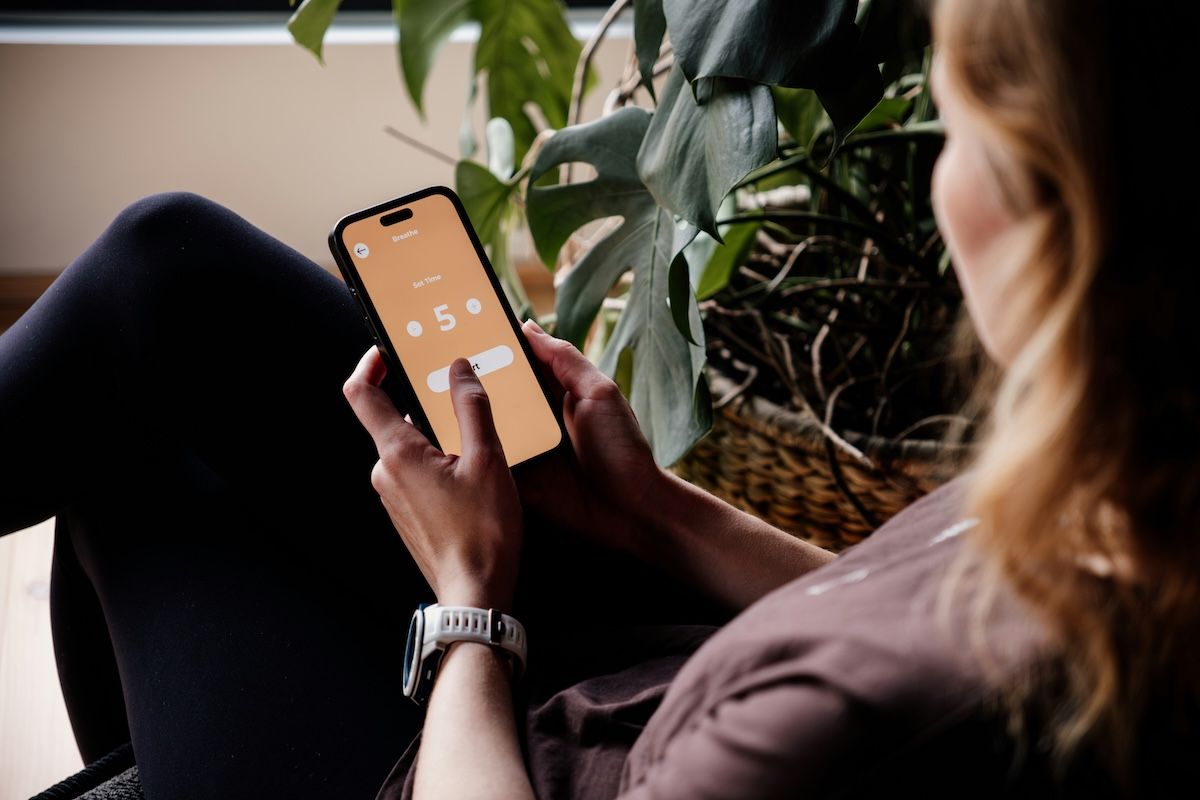
5. Use meditation to encourage mindful phone use
Research shows that a 30-minute mindfulness intervention can help strengthen self-control and directly reduce impulsive smartphone behaviors. What’s a mindfulness intervention? It can consist of simple breathing exercises and body scanning, both of which train you to keep your attention on the present moment.
As you practice focusing your attention and resisting mental distractions during meditation, you’re building the same self-control muscle needed to resist the urge to check your phone impulsively (Liu et al., 2022).
Other ways to encourage mindful phone use:
- Use app timers to limit social media use.
- Turn off non-essential notifications.
- Switch your phone to grayscale mode (makes scrolling way less appealing).
- Ask yourself “What am I looking for?” before picking up your phone.
6. Audit your digital diet
Take an honest look at what you’re consuming online and consider doing one or all of the following:
- Unfollow accounts that make you feel inadequate, anxious, or angry.
- Curate your feed to include educational, inspiring, or genuinely helpful content.
- Limit news consumption to once or twice daily.
- Subscribe to newsletters or podcasts that align with your wellness goals.
7. Create connection rituals
Social connection significantly impacts health through biological, psychological, and behavioral pathways, with relationships rated globally as the most important source of meaning and purpose (U.S. Surgeon General, 2023).
Build regular, non-digital ways to connect through:
- Weekly coffee dates with friends
- Monthly dinner parties
- Joining a book club or sports league
- Volunteering in your community
How to stick to digital boundaries long term
In order for a boundary to be effective, you have to believe that sticking to that boundary is going to lead to a worthwhile reward. That’s why the best boundaries connect to your personal values.
Think of your personal values as your internal compass—the things that matter most to you and guide how you want to live your life. They’re shaped by your goals, beliefs, culture, personality, and life experiences. The tricky part? We don’t always take time to actually identify what our values are, let alone check if we’re living by them.
One way to zero in on your values is to use the Wellness Wheel. The goal of the wheel is to help you identify values that contribute to your overall wellbeing. It breaks down wellness into eight dimensions: emotional, physical, financial, social, occupational, environmental, intellectual, and spiritual. Taking the free assessment can help you figure out which areas of your life need attention and which values you might be neglecting.
Once you’ve identified your values, you can confidently set digital boundaries with the goal to reclaim that time and devote it to an activity that you value deeply. The promise of this reward gives you the motivation you need to actually follow through.
When should I talk to a therapist about digital burnout?
A common misconception about therapy is that your life has to be falling apart before you “deserve help.” If you feel that you’re unable to set or follow through on digital boundaries and that it’s impacting your life in a negative way, seeing a therapist can help you align your actions with your personal values. Often, the best way to determine if therapy is right for you is to talk to a therapist. Therapy consultations are typically free and give you a chance to ask questions and make an informed decision.
Another misconception is that therapy takes a long time before it starts to “work.” While in some cases there is good reason to engage in long-term therapy, when it comes to changing specific behavior, modalities like Cognitive Behavioral Therapy, Solutions-Focused Therapy, and Dialectical Behavioral Therapy can often lead to faster results.
Setting digital boundaries is uncomfortable, but worth it!
You can’t skip straight to well-being (the results) without doing the wellness work (the daily choices you make). The goal isn’t to abandon technology or pretend we are back in the early 90s. The goal is to use technology intentionally, in ways that serve our values rather than undermine them.
So as you plan your next chapter, get curious:
- What matters most to you?
- How do your digital habits support or sabotage those values?
- And what’s one small boundary you could set today that would move you closer to the life you actually want to be living?
Take action:
Take Action
Connect with a therapist who can help you align your digital habits with your values
You've recognized that your relationship with technology might be pulling you away from what truly matters—whether that's being present with loved ones, advancing your career goals, or simply having control over your own time. A therapist can help you identify your core values, understand why certain boundaries feel impossible to maintain, and develop personalized strategies for creating the intentional, fulfilling life you want. The reality is that changing ingrained digital habits often requires more than willpower alone—it takes understanding the underlying patterns and having support as you build new ones.
References
De-Sola Gutiérrez, J., Rodríguez de Fonseca, F., & Rubio, G. (2016). Cell-phone addiction: A review. Frontiers in Psychiatry, 7, 175. https://doi.org/10.3389/fpsyt.2016.00175
Liu, F., Zhang, Z., Liu, S., & Feng, Z. (2022). Effectiveness of brief mindfulness intervention for college students' problematic smartphone use. PLOS ONE, 17(12), e0279621. https://doi.org/10.1371/journal.pone.0279621
Roberts, J. A., Young, P. D., & David, M. E. (2024). The epidemic of loneliness: A 9-year longitudinal study of the impact of passive and active social media use on loneliness. Journal of Personality and Social Psychology. https://doi.org/10.1177/01461672241295870
University of New Hampshire Cooperative Extension. (n.d.). Wellness Wheel Assessment. https://extension.unh.edu/programs/wellness-wheel-assessment
U.S. Surgeon General. (2023). Our epidemic of loneliness and isolation. U.S. Department of Health and Human Services. https://www.hhs.gov/sites/default/files/surgeon-general-social-connection-advisory.pdf
Related Articles





Jan 21, 2026




Looking for a therapist?
Get tips on finding a therapist who gets you.
By submitting this form, you are agreeing to Alma's privacy policy.