Templates & Worksheets
ACT Matrix Worksheet: Help Clients Align Their Values and Actions
Last updated: June 2026
With this resource, you’ll learn how to:
Introduce the ACT Matrix in session
Guide clients step-by-step
Address the functional loop
When clients feel stuck, the problem is often that they can't see the relationship between their thoughts, feelings, and behaviors. When integrated into therapy sessions, the ACT Matrix can help provide new clarity and invite change.
This free worksheet is designed for clinicians who want a structured way to introduce the matrix in session.
What is the ACT Matrix?
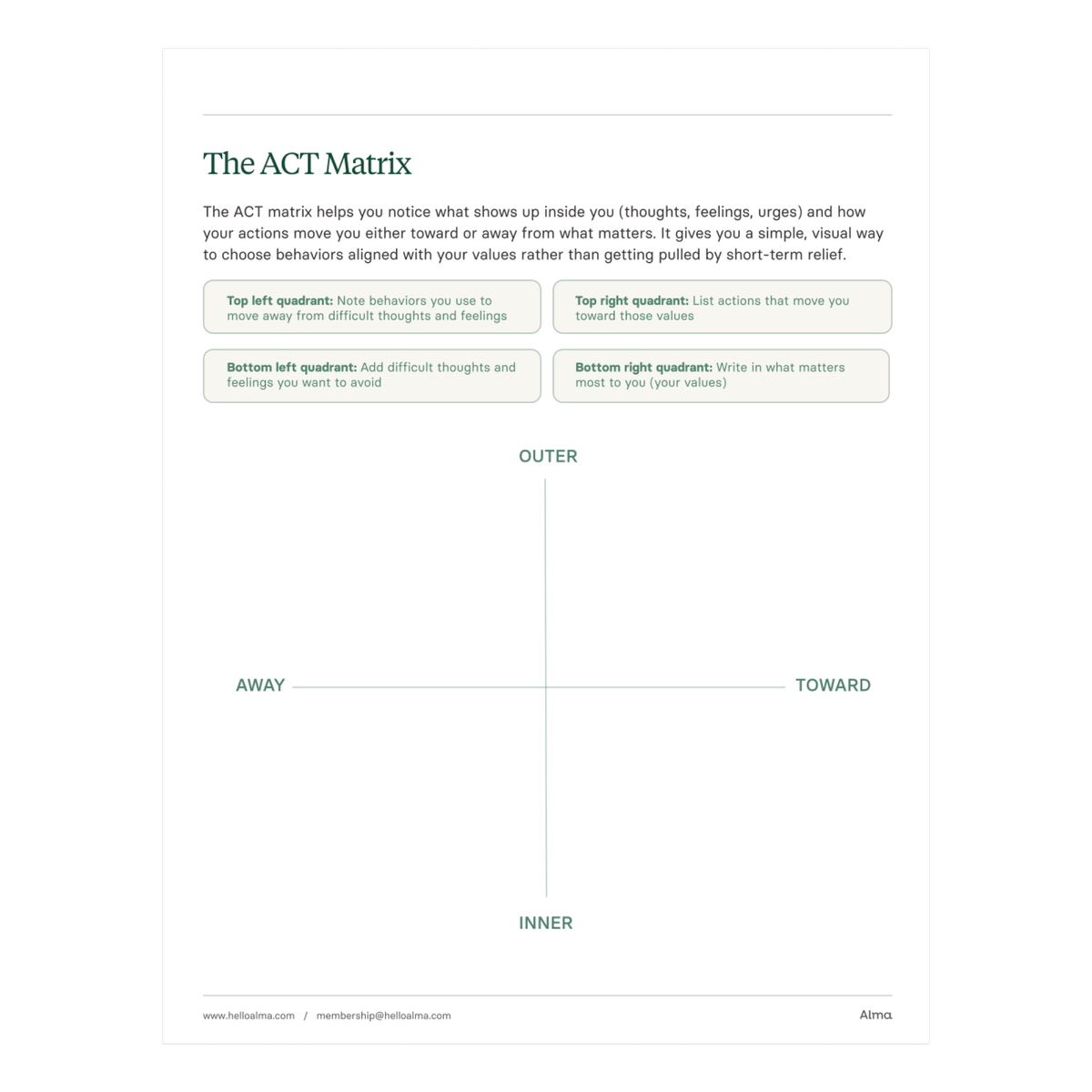
Developed by psychologist Kevin Polk, the ACT Matrix is a simple, four-quadrant graphic, rooted in Acceptance and Commitment Therapy. It helps to organize a client's experience by prompting them to think about the things in life they most want to move toward (i.e. their values) and the things tend to get caught up trying to move away from (i.e. painful thoughts and feelings).
It then invites them to acknowledge the behaviors they engage in to avoid or lessen pain — and examine the impact of those behaviors in relation to their values. Finally, it creates space for brainstorming alternate responses that may be more value-aligned.
The power of the Matrix is not only that it can introduce awareness and agency, but also self-compassion.
How to introduce the ACT Matrix in session
Orient the client before you begin. You might say: "We are going to do an activity together that will allow us to examine some patterns in terms of how you relate to your thoughts and feelings, and see if we can create space for change."
You can choose which quadrant to start with, or let the client lead.
The internal pain quadrant — what they want to get away from. Thoughts and feelings cause the client to feel stuck, self-critical, afraid, or ashamed.
Useful questions:
- What shows up in your mind that causes you to experience pain or struggle?
- How does it show up in your body? In your thoughts? In your emotions? In your urges? In your memories?
- What kinds of thoughts tend to “hook you” or “push you around”?
The external coping mechanisms quadrant — what they do in response. Behaviors they habitually turn to avoid, lessen, or distract from the pain.
Useful questions:
- What kinds of things do you do when these painful thoughts, feelings, or memories show up?
- If I was there with you in the moment, what would I see you doing?
A helpful framework here is DOTS: clients tend to Distract, Opt out or avoid, Think or problem-solve, or turn to Substances or numbing. It's worth naming this directly: these behaviors work in the short term and provide real relief — that's why people do them.
The values quadrant — who and what matters most. These are the experiences and goals that give the client’s life meaning and purpose.
Useful questions:
- Who or what is most important to you in your life?
- What would you want to be doing if your pain disappeared?
- At the end of your life, what do you want to look back on?
Pain can actually be a back door into values: what someone most wants to avoid losing often points directly to what they most care about.
The committed action quadrant — things they could do that would move them in the direction of their values, even in the presence of pain. Once the stuck loop between pain and avoidance is visible, you can invite the client to consider something new.
Useful questions:
- Does it make sense for us to create space for something different?
- Is there something that might work better in terms of you being able to choose to take your life in the directions that are most important to you?
- If this pain were to go away, what would I see you doing more of?
- How much are you able to engage in these behaviors when you are busy engaging in avoidant behaviors?
Addressing the functional loop
When the matrix is complete, you've co-created a context in which you can invite the client to notice the relationship between their pain and the behaviors they use to escape it. This is sometimes called the functional loop. Seeing this loop clearly is often a turning point in therapy.
The loop works like this: a painful thought or feeling shows up, the client engages in an avoidance behavior to get relief, and the relief works, at least temporarily. But the pain comes back and the avoidance behavior can create new problems of its own. The client who drinks to soothe anxiety may wake up with more of it. The person who withdraws from relationships to avoid rejection may find themselves lonelier and more convinced they're unlovable.
The goal isn't to shame clients for these patterns, but to help them see them. When a client can observe the loop with some distance, they gain a choice to act differently, in a way that aligns with their deepest values.

Written by
Elisabeth Morray, PhD


Learn More
Build a thriving private practice with Alma
We believe that when clinicians have the support they need, mental health care gets better for everyone.