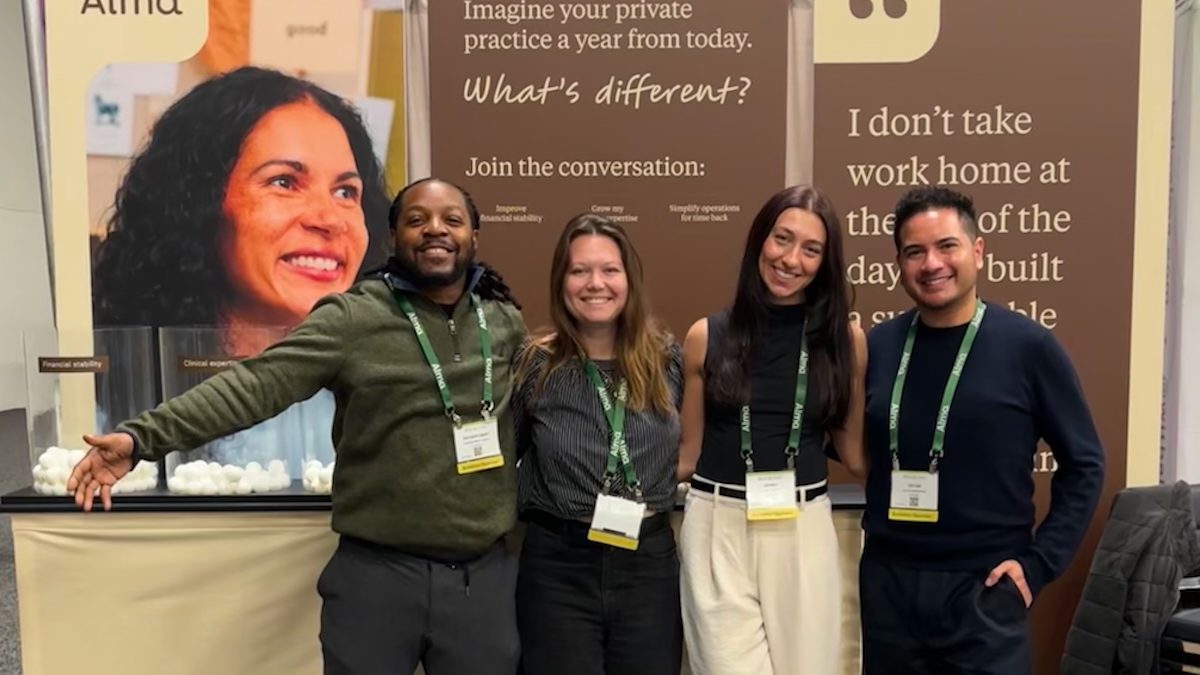
Sessions at the American Counseling Association’s annual conference are always timely, and this year’s agenda was no exception. Several talks focused on the ethical use of AI in mental health, as well as how to serve populations impacted by the latest political shifts and medicare cuts. Speakers from across the field — including Alma’s VP of Clinical Elisabeth Morray, PhD — also offered advice on how therapists can find stability in an industry going through transformational change.
Between sessions, Alma staffers connected with counselors to talk about how, amidst all this change, they’re making space for their longterm goals. We asked each provider a simple but important question: What do you want your private practice to feel like a year from today?
To make things a little more fun and visual, we asked them to vote for their top private practice goal using a ping-pong ball.
Having a ball — and gaining insight
We invited counselors to place a ping pong ball into just one of three clear containers. Each container was labeled with a goal: “greater financial stability,” “expanded clinical expertise,” and “simplified workflows.” Before long, we noticed one container filling up a little faster than the others.


Here’s where the ping pong balls landed:
- 48% Greater financial stability
- 30% Expanded clinical expertise
- 22% Simplified workflows
As we chatted with counselors about what they chose and why, we gathered helpful insights into what’s top of mind for clinicians in 2026.
Greater financial stability
While each provider we spoke with told a nuanced story, the majority shared a sense of urgency around making their practice more financially stable.
Alma’s Field Marketing Manager, Holly West, talked to dozens of counselors about their financial concerns. “One thing that came up often was that having a stable, profitable practice is key to being the best possible clinician,” she noted. “It’s difficult to be clinically present when you’re worrying about how to make a living.”
Factors like medicare cuts, the cost of specialty drugs, and an aging population are putting pressure on insurance companies to reduce spending. This translates to stagnant or lower reimbursement rates and increased audits. As cost of living increases, therapist are finding it harder to grow their income while working with insurance.
One of the most common reasons providers join Alma is because we are often able to negotiate better rates with insurance providers. To find out how your rates might improve as an Alma member, get started here.
Expanded clinical expertise
Gaining clinical expertise in the company of their peers is what draws counselors to the ACA conference, so it’s fitting that nearly 1 in 3 providers we spoke with chose this as their top goal for 2026.
Here’s what they told us:
- I want to continually develop my clinical skills for myself and my clients, but also for the many clinicians I supervise. I owe it to them to be a go-to resource.
- I chose growing clinical expertise because I’m in my last year as a Ph.D candidate and want to soak up as much learning as I can.
- Developing my clinical expertise ultimately is what leads to financial growth and so I always want to center myself around the care I provide.
The connection between clinical growth and financial health was a theme that came up often throughout the weekend. To appeal to more clients, providers were attending sessions on modalities like EMDR and ACT, and looking to deepen their expertise with specific populations, including older adults and women in perimenopause and menopause.
For providers looking to grow their skillset, Alma’s Education Center is accredited by the APA, NASW, and NBCC boards, and offers free, unlimited CE courses to members. Members can also participate in practice growth workshops and community events focused on consulting, public speaking, content creation, and other ways to leverage their expertise.
Simplified workflows
Many providers shared that while they love clinical work, managing the operational side of private practice — whether it’s compliant documentation or making time to source new clients — can feel overwhelming.
Across conversations, we heard that providers want:
- Less time spent on billing and credentialing
- Less switching between platforms
- Tech that delivers on its promises
They’re also open to experimenting with AI to discover how it can support their clinical work and reduce admin time.
“At first I was very skeptical of using AI in my practice,” shared one ACA attendee, “But I decided to test it out to understand how it might help. I’ve used it to draft clinical notes and documentation, and it’s been a game changer so far.”
As the risks and benefits of AI in mental health become more clear, Alma will continue integrating AI-supported tools in partnership with its Clinical Advisory Board as well as its Security and Privacy Teams. Members now have access to Note Assist, a HIPAA compliant note-taking tool that helps providers quickly draft compliant notes.
Let’s keep the conversation going
The clinicians we met in Columbus were juggling a lot. And that's true of every provider we talk to. Client care, running a business, and living a full life outside of work is a lot to hold — but you can still achieve big goals for your practice.
Alma is here to help you reach those goals. We take care of insurance access, billing support, clinical tools, ongoing education — and keep you connected to your peer community. That way you have more time, inspiration, and support to take your practice where you want it to go.
We’ll leave you with the same, important question: What do you want your practice to feel like a year from today?
Take action:
Achieve your goals with Alma
If you dropped by our booth at the ACA, thank you for sharing your time and your goals. And if we didn’t get a chance to meet, we’d still love to connect and discuss how Alma can help you meet your private practice goals.
Related Articles


Apr 15, 2026


Looking for a therapist?
Get tips on finding a therapist who gets you.
By subscribing to emails from Alma, you are agreeing to Alma's privacy policy.